





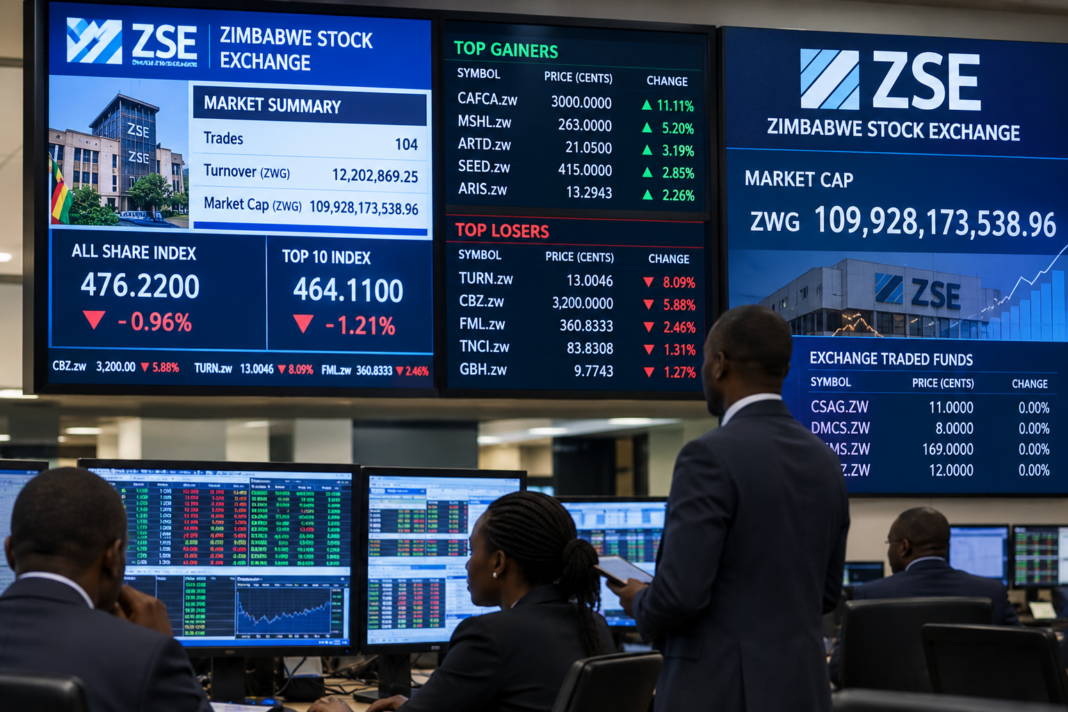
HARARE — Zimbabwe Stock Exchange (ZSE) equities weakened on October 9 as losses in financial and materials counters pulled the headline indices lower, while the Victoria Falls Stock Exchange (VFEX) recorded a modest gain, reflecting contrasting movements across Zimbabwe’s two equity markets.
The ZSE All Share Index fell 0.96% to 476.22 points, while the ZSE Top 10 Index declined 1.21% to 464.11 points. The Top 15 Index lost 1.08% to 476.45 points, signalling broad weakness among larger listed companies.
The market recorded 104 trades, generating turnover of ZWG12.20 million. Total market capitalisation stood at approximately ZWG109.93 billion.
The declines came amid a mixed sectoral performance, with the financials and materials indices recording the sharpest losses. The financials index fell 2.93%, while the materials index dropped 3.57%. The Old Industrial Index declined 0.92%, adding to the downward pressure on the broader market.
Financial and materials stocks lead declines
CBZ Holdings was among the session’s biggest losers, falling 5.88% to 3,200 cents. Turnall Holdings dropped 8.09% to 13.0046 cents, while FML declined 2.46% to 360.8333 cents. Truworths-related counter TNCI lost 1.31% to 83.8308 cents, while GB Holdings eased 1.27% to 9.7743 cents.
The weakness in financial shares was consistent with the decline in the sectoral index, although the supplied data does not establish whether the movement reflected company-specific developments, investor positioning or broader market sentiment.
Materials stocks also faced pressure, with the sector index falling 3.57%. The mining index, however, was unchanged at 155.31 points, indicating that the weakness was not uniform across all resource-related counters.
The market’s performance illustrates the importance of looking beyond the headline index. Sectoral movements can diverge substantially, while individual share prices may respond to company-specific announcements, earnings expectations and liquidity conditions.
Selected industrial stocks buck the trend
Despite the broader decline, several counters advanced sharply.
CAFCA led the gainers, rising 11.11% to 3,000 cents. Mashonaland Holdings gained 5.20% to 263 cents, while ART Holdings advanced 3.19% to 21.05 cents. Seed Co rose 2.85% to 415 cents, and Ariston Holdings increased 2.26% to 13.2943 cents.
The New Industrial Index was a notable outperformer, climbing 2.88% to 200.87 points. The agriculture index rose 0.26%, while the real estate index gained 0.17%. Consumer staples edged up 0.07%, and the consumer discretionary index remained unchanged.
The Small Cap Index was flat at 100.11 points, while the Mid Cap Index slipped just 0.02% to 560.70 points.
The divergent performance suggests that investors were not selling indiscriminately across every segment of the market. However, one session’s movements are insufficient to establish a sustained rotation towards industrial or agricultural shares.
VFEX records modest advance
The VFEX delivered a more positive headline performance, with its All Share Index rising 0.17% to 269.47 points.
The US-dollar-denominated exchange recorded 195 trades and daily turnover of US$806,497.98. Its reported market capitalisation stood at approximately US$9.01 billion.
Eagle Insurance was the weakest counter among the listed VFEX movers supplied, falling 9.14% to US$0.3003. Seed Co International declined 2.43% to US$0.3903, while Zimre Holdings-related ZIMW fell 1.67% to US$0.1180. Simbisa Brands eased 1.62% to US$0.6870, and First Mutual-related FMWG declined 0.85% to US$0.1173.
The VFEX’s positive index performance alongside several declining counters underscores the difference between an index’s aggregate movement and the performance of individual securities.
The two exchanges also operate with different currency and market structures. The ZSE reports its market activity in Zimbabwe Gold (ZWG), while VFEX trading is denominated in US dollars. Their headline turnover and market-capitalisation figures therefore should not be compared directly without accounting for the currency difference and the composition of each market.
Zimbabwe’s economic environment remains central to valuations
For Zimbabwean investors, listed-equity performance sits within a broader economic environment shaped by currency stability, inflation, interest rates, access to foreign currency and the availability of productive investment opportunities.
Companies with pricing power, resilient cash flows and the ability to preserve margins may attract different investor responses from businesses more exposed to changes in domestic demand, operating costs or financing conditions. But share-price movements alone do not establish whether a company’s underlying financial position has improved or deteriorated.
The distinction is particularly important in a market where investors assess both nominal share-price changes and the preservation of purchasing power. Market capitalisation measures the quoted value of listed equity, but does not independently establish the real growth in shareholder wealth or the ease with which investors can sell their holdings at prevailing prices.
The session’s turnover figures also provide only part of the liquidity picture. The number of trades and total value exchanged help indicate market activity, but assessing liquidity more fully requires information on bid-offer spreads, trading depth and the concentration of transactions.
Corporate announcements remain in focus
The ZSE’s latest announcements included a circular to shareholders and notices for annual and extraordinary general meetings from Meikles, alongside a notice concerning the appointment of directors at Tanganda Tea Company. GetBucks Microfinance Bank also had unaudited half-year financial results listed among the recent announcements.
Such disclosures can be important to investors evaluating corporate governance, capital allocation and company performance. Their implications depend on the detailed contents of the documents and any resulting decisions by shareholders or regulators.
For the wider market, the immediate picture was one of weakness in the ZSE’s headline indices, pronounced losses in financial and materials shares, and selective gains among industrial and agricultural counters. The VFEX’s modest advance offered a contrasting outcome, although several of its individual securities still closed lower.
The next test for investors will be whether these divergent movements persist across subsequent sessions and whether company fundamentals, liquidity and the wider economic environment provide support for a sustained market recovery.


