





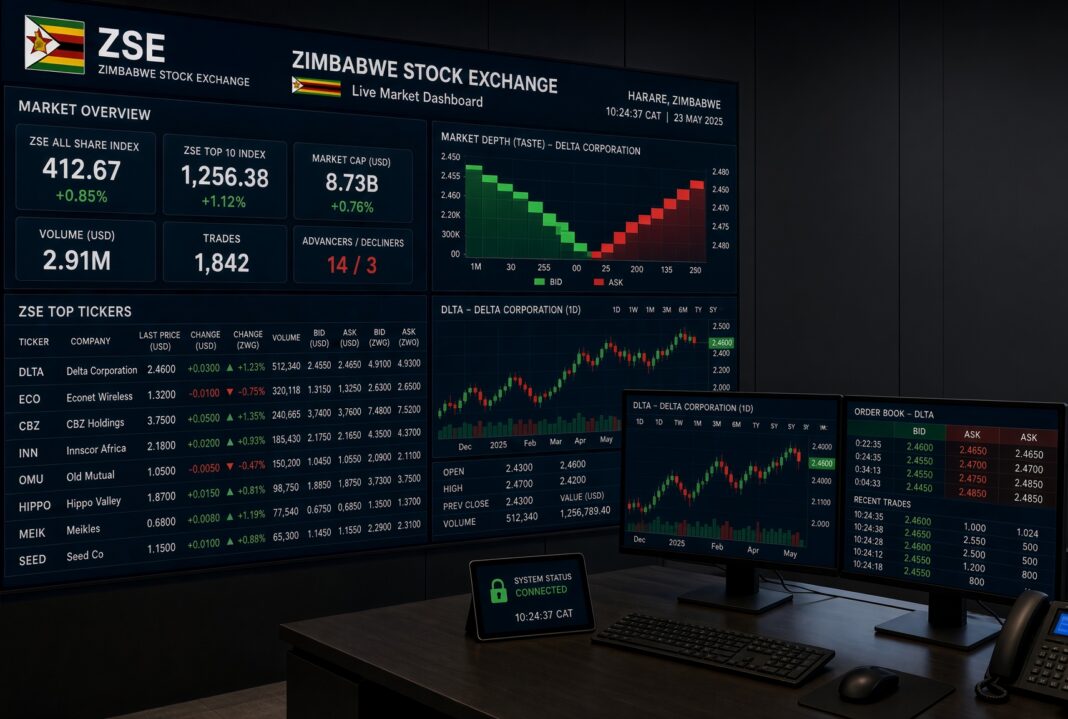
HARARE — Zimbabwean shares recovered on Wednesday, led by financial stocks, but thin turnover underscored the shallow liquidity that continues to constrain the domestic equity market.
The ZSE All Share Index rose 0.44% to 480.83 points, while the Top 10 gained 0.29% and the Top 15 advanced 0.55%. The Mid Cap Index was the strongest performer, climbing 1% to 560.79 points.
Market capitalisation increased to ZWG111.23 billion, but only 66 trades were recorded, generating ZWG3.81 million in turnover.
ZIMRE led the market, surging 14.27% to 80 cents. First Mutual Holdings jumped 13.72% to 369.93 cents, while Ariston gained 9.22% and Afdis rose 4.35%.
SACL was the biggest faller, down 4.56%, while TNCI lost 1.18%. Meikles, Delta Corporation and FBC posted marginal declines.
The Financials Index rose 1.15%, providing the strongest sectoral support. The Old Industrial Index gained 0.46%, while the Top 25 advanced 0.45%.
Analysts who spoke to The Zimbabwe Financial Mail said the rebound reflected selective buying rather than a broad shift in market sentiment, with investors favouring companies offering stronger earnings visibility, balance sheets or corporate catalysts.
Liquidity remains a key constraint. Zimbabwe’s relatively small pool of institutional and retail capital, alongside competition from property and US dollar assets, continues to limit trading depth on the ZSE.
Bloomberg has previously highlighted the pressure on Zimbabwe’s traditional exchange from capital moving towards property and dollar-denominated investments. In April, it reported that the Victoria Falls Stock Exchange had overtaken the ZSE in market value following the transfer of Econet InfraCo to the US dollar-denominated bourse.
That divergence was again visible on Wednesday. VFEX’s All Share Index fell 0.29% to 269.02 points, with market capitalisation at US$9.01 billion and turnover of US$1.04 million from 190 trades.
TSL fell 6.86%, Invictus Energy declined 3.83%, Pfuma Reit lost 3.72%, Axia dropped 2.76% and Innscor Africa fell 1.08%.
The contrasting performance of the two exchanges reflects an increasingly important feature of Zimbabwe’s capital markets: investors can choose between ZiG-denominated securities on the ZSE and US dollar assets on VFEX.
Zimbabwe’s improving macroeconomic stability could eventually support deeper equity-market participation. Annual ZiG inflation was 3.7% in September, while the exchange rate has remained relatively stable.
But analysts said stability alone would not be enough to deepen the market. The bigger test is whether improved monetary conditions translate into stronger corporate earnings, new listings and greater institutional investment.
For Thursday’s session, the message from the previous day’s trading was therefore mixed: Zimbabwean shares can attract strong buying when investors identify value, but the ZSE still needs substantially deeper liquidity before a daily index rebound can be interpreted as a durable change in investor confidence.


