





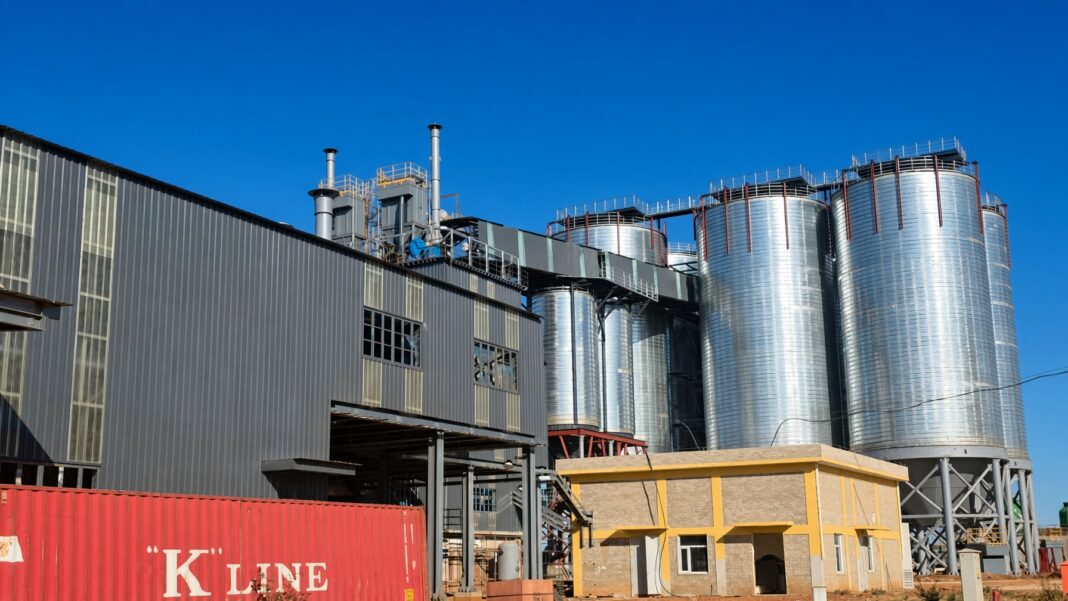
HARARE — Shuntai Investments’ US$120 million cement project in Chegutu is approaching commissioning, with mechanical installation of its 800,000-tonne-a-year cement production line scheduled for completion by 20 October 2026 and integrated commissioning targeted for mid-November.
The project is emerging as one of Zimbabwe’s more significant recent manufacturing investments, adding substantial domestic cement capacity at a time when construction activity, mining investment, housing development and infrastructure projects are placing pressure on local supplies.
Shuntai general manager Li Xiaodong said the mechanical installation programme was progressing towards the October deadline, followed by cable laying, wiring, grounding and integrated commissioning. The company is also developing a 400,000-tonne-a-year lime production line at the site.
The integrated project includes a planned 50MW thermal power plant, limestone mining and logistics operations, with the first phase expected to create about 1,000 jobs.
The employment figure comprises approximately 400 positions at the cement production line, 100 at the power plant, 100 in limestone mining, 100 in production-related operations and 300 in logistics, according to the company.
New capacity arrives as cement imports rise
The timing of the investment is significant for Zimbabwe’s construction economy.
Cement demand has been supported by housing construction, commercial property, mining developments, roads and other infrastructure projects. At the same time, domestic supply constraints have resulted in increased imports, with Zimbabwe’s Portland cement import bill reaching about US$12.02 million in April 2026, according to industry analysis.
An analyst who spoke to The Zimbabwe Financial Mail said Shuntai’s importance should therefore be measured by effective output rather than simply its installed capacity.
“The key issue for Zimbabwe is not whether another 800,000 tonnes of theoretical capacity exists. It is whether that capacity operates reliably and consistently. If the plant achieves high utilisation, it could materially alter the balance between domestic production and imports.”
At 800,000 tonnes annually, the Chegutu plant represents a substantial addition to a Zimbabwean market estimated by industry sources at roughly 1.3 million to 1.5 million tonnes of annual consumption.
That makes reliable commissioning particularly important for builders and distributors that have periodically had to contend with supply constraints and imported cement.
From construction project to industrial asset
The Chegutu investment is significant because it goes beyond a conventional cement grinding operation.
Shuntai is developing an integrated industrial complex incorporating limestone mining, cement production, lime manufacturing, power generation and logistics.
That structure could give the company greater control over critical inputs while reducing exposure to imported clinker and external energy disruptions.
“The integrated nature of the investment is arguably more important than the headline US$120 million,” a second analyst told The Zimbabwe Financial Mail.
“Zimbabwe needs industrial projects that create linkages. Limestone mining supports manufacturing, manufacturing supports transport and distribution, and the power component addresses one of the biggest constraints facing industry. That creates a much broader economic footprint than a standalone grinding plant.”
Power security becomes part of the investment case
The planned 50MW thermal power plant reflects a wider challenge confronting Zimbabwean manufacturers: electricity reliability.
Energy shortages have historically disrupted industrial production, forcing businesses to rely on diesel generation, alternative power sources or reduced operating hours.
For a cement manufacturer, where kilns, grinding equipment and other heavy industrial machinery require continuous power, electricity reliability is particularly important.
Shuntai has also previously outlined renewable-energy infrastructure as part of its broader investment programme, including a planned 50MW solar facility.
The company’s approach illustrates how Zimbabwean industrial investors are increasingly treating energy generation as part of the manufacturing asset rather than relying exclusively on the national grid.
That has implications beyond Shuntai.
If large industrial projects increasingly develop captive generation, the model could reduce production risk while simultaneously creating opportunities for Zimbabwe to develop a more diversified industrial energy system.
Phase two takes Shuntai beyond Chegutu
The Chegutu project is intended to be the first stage of a much larger national expansion.
Shuntai plans to begin its second phase in January 2027, with a proposed 6,000-tonne-per-day clinker production line in Zvishavane, alongside additional power-generation capacity.
The company also plans cement-grinding operations in major centres: Harare: 1 million tonnes a year, Bulawayo: 500,000 tonnes a year, Mutare: 500,000 tonnes a year.
The planned geographical spread would allow Shuntai to position production closer to major construction markets while reducing the logistical cost of transporting cement over long distances.
For Zimbabwe, that could be particularly important because transport costs can materially influence the final price of bulky construction materials.
Cement investment could deepen Zimbabwe’s manufacturing base
The project arrives as Government seeks to increase domestic manufacturing, value addition and industrial capacity.
Cement is strategically important because it is an essential input into virtually every major infrastructure programme, from housing and roads to mines, factories, dams and commercial buildings.
An increase in domestic cement production could therefore have a multiplier effect across the construction economy.
“If Shuntai reaches commercial production on schedule, the impact will extend beyond the cement industry,” the first analyst said.
“You potentially have more local procurement, transport demand, engineering services, employment, mining activity and tax revenues. The economic value is created through the supply chain as much as through the cement plant itself.”
That is particularly relevant to Zimbabwe’s attempt to increase domestic production and reduce dependence on imported manufactured goods.
Competition could pressure cement prices
The arrival of additional capacity could also alter competitive dynamics within Zimbabwe’s cement industry.
Established producers have historically operated in a market where supply constraints could support relatively strong pricing. A reliable new entrant with substantial capacity could increase competition for distributors and construction companies.
However, analysts cautioned against assuming that additional capacity would automatically translate into sharply lower prices.
“Cement pricing will depend on utilisation, energy costs, limestone quality, transport, financing costs and the wider exchange-rate and inflation environment,” the second analyst said.
“The investment should improve supply security first. Whether it produces materially cheaper cement will depend on the producer’s cost structure and how efficiently the additional capacity is utilised.”
Employment is only the first economic dividend
The planned 1,000 jobs in the first phase provide an immediate benefit to Chegutu and surrounding communities, but the longer-term economic impact could be considerably larger.
A large cement operation requires transporters, maintenance contractors, equipment suppliers, fuel providers, engineers, construction specialists, security companies and other service businesses.
The logistics component alone is expected to account for about 300 jobs in the first phase.
This creates the possibility of a broader industrial cluster developing around Chegutu if local suppliers are able to meet the project’s procurement requirements.
For Zimbabwe’s manufacturing sector, that is arguably more important than the headline employment number.
The country’s challenge is to convert large foreign and domestic investments into productive local supply chains, rather than allowing major projects to function as isolated enclaves with limited domestic economic linkages.
From cement imports to domestic capacity
The Shuntai project could therefore help address one of the contradictions in Zimbabwe’s construction economy: strong demand for infrastructure alongside periodic dependence on imported cement.
Industry analysis has indicated that cement imports increased sharply through late 2025 and early 2026 as effective domestic supply struggled to keep pace with demand.
The Chegutu plant will not eliminate that problem overnight. Commissioning, testing, kiln stability, distribution and market penetration will determine how quickly the additional capacity translates into actual cement availability.
But if the facility reaches its planned 800,000-tonne annual output, Zimbabwe will have a significantly larger domestic production base.
The bigger test is utilisation
For investors and policymakers, the next milestone is therefore not simply commissioning.
It is capacity utilisation.
A cement plant capable of producing 800,000 tonnes but operating intermittently would have a much smaller economic impact than a plant producing consistently near its design capacity.
The same applies to Shuntai’s planned national expansion.
The proposed Zvishavane clinker operation and grinding facilities in Harare, Bulawayo and Mutare could eventually create a substantial national manufacturing network, but their economic value will depend on capital deployment, reliable energy, market demand and operational efficiency.
The investment therefore provides Zimbabwe with an opportunity to move beyond measuring industrialisation by the number of projects announced.
As one analyst put it: “The real measure of industrialisation is not how much capital is announced. It is how much productive capacity actually comes online, how many tonnes are produced, how many businesses enter the supply chain and how much value remains in the domestic economy.”
For Shuntai, the immediate test is straightforward: complete mechanical installation by October, commission the Chegutu plant in November and demonstrate that the 800,000-tonne annual capacity can be converted into reliable commercial output.
If successful, the project could mark an important expansion of Zimbabwe’s cement manufacturing base — while its planned second phase could turn Shuntai from a new Chegutu producer into a national industrial player.


