





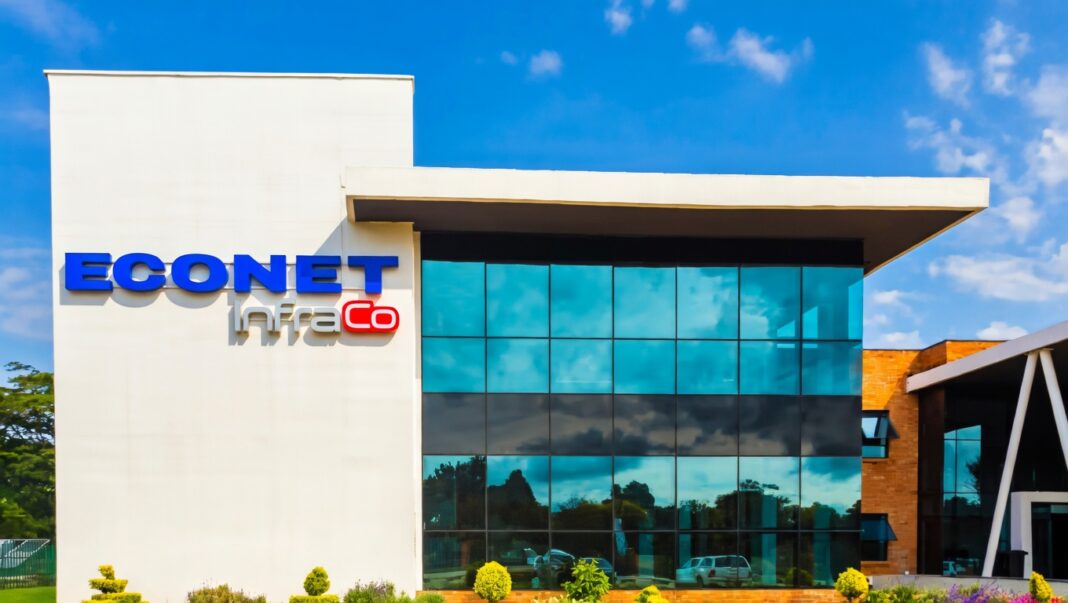
HARARE,— Econet Infrastructure Company (InfraCo) reported a profit after tax of US$13.7 million for the six months to August 31, 2026, in its first half-year results since listing on the Victoria Falls Stock Exchange (VFEX) in March.
The infrastructure company generated US$70.1 million in revenue, with US$30.8 million coming from tower and property rentals and US$39.3 million from electricity supplied to telecommunications sites.
Econet Wireless Zimbabwe and related group companies accounted for US$69 million, or about 98% of revenue, underscoring both the strength of InfraCo’s relationship with its parent group and the challenge of diversifying its customer base.
InfraCo was created after Econet transferred its telecommunications towers, power infrastructure, land and buildings into the business. Econet retained a 70% stake, while 30% was distributed to its existing shareholders before the VFEX listing.
Analysts who spoke to The Zimbabwe Financial Mail said the company’s investment case would increasingly depend on whether it can evolve from an infrastructure vehicle serving Econet predominantly into a genuinely independent tower and energy platform.
“The first set of results demonstrates that the asset base can generate substantial earnings. But the strategic question is what happens when InfraCo starts adding customers beyond Econet. That is where the real operating leverage lies,” one analyst said.
Tower infrastructure has significant economies of scale because the cost of maintaining a site does not rise proportionately when additional telecommunications operators share the same structure.
The opportunity is particularly significant in Zimbabwe, where NetOne and Telecel operate thousands of mobile sites alongside Econet. Bringing those networks onto shared infrastructure could increase InfraCo’s revenue while reducing duplication of towers, power systems and associated capital expenditure across the industry.
“A three-operator tenancy model would fundamentally change the economics of InfraCo. Incremental tenants can generate significant additional revenue without requiring the same level of additional infrastructure investment,” another analyst said.
However, third-party business remains limited. External customers contributed only about US$1.1 million during the half year, highlighting the distance between InfraCo’s current model and its potential positioning as a national telecommunications infrastructure company.
Energy remains another major determinant of profitability. Diesel and other energy costs amounted to US$21.1 million, accounting for more than 60% of direct costs.
InfraCo said investments in solar, batteries, artificial-intelligence-enabled generator management and improved grid supply had reduced fuel consumption by about 30%.
The company has also begun construction of the first phase of a 100MW solar project at Tech City near Robert Gabriel Mugabe International Airport, with initial power generation expected in early 2027.
Analysts said the shift towards renewable energy could materially improve margins if the company can reduce its dependence on diesel-generated power.
“Energy is one of the highest controllable costs in a tower business. The solar investment is therefore not simply an environmental initiative; it has a direct bearing on the company’s long-term operating margins and cash generation,” an analyst said.
InfraCo reported operating profit before depreciation, interest and tax of US$29 million, although operating cash generation was considerably lower at US$14.2 million.
The company had US$21.4 million owed by Econet-related entities at the end of August, raising the importance of working-capital management as InfraCo expands its capital programme.
Capital expenditure during the period included US$6.5 million on equipment and US$5.3 million on leases, leaving cash of about US$2.6 million. The board has approved a further US$22.4 million investment programme, expected to be funded through internally generated cash and additional borrowing where necessary.
InfraCo’s assets stood at US$255.2 million, against liabilities of US$93.7 million. Its principal obligations included a US$26.6 million loan from an Econet group company and US$21.3 million in lease liabilities.
The company’s relatively modest leverage provides room to fund further infrastructure investment, although analysts said cash conversion would become increasingly important as the business expands.
The stock has also come under pressure since its VFEX debut. After listing at a valuation of about US$1 billion, InfraCo closed at 30 US cents on its first trading day. By September 18, the share price had fallen to 22.7 US cents, implying a market value of approximately US$679 million.
Trading remains thin, with only about US$7,100 worth of shares changing hands on September 18, making the quoted valuation less reliable as a measure of broad investor sentiment.
“The valuation needs to be judged against future earnings rather than simply the first half’s profit. Investors are effectively paying for the prospect of higher tower tenancy, lower energy costs and stronger cash generation,” another analyst said.
InfraCo’s first results therefore present a mixed but potentially significant investment story: a sizeable asset base, strong earnings and substantial operating leverage, but heavy dependence on Econet, limited external revenue and a significant opportunity still to be converted into actual business.
For Zimbabwe’s telecommunications sector, the broader prize could extend beyond InfraCo’s shareholders. Greater infrastructure sharing among operators could reduce duplicated investment in towers and power systems, potentially lowering the cost of extending reliable mobile coverage into underserved areas.
“If InfraCo can become a neutral infrastructure platform used by all major operators, the economic benefit could extend beyond the company itself. Shared infrastructure can lower industry costs and make rural network expansion more commercially viable,” an analyst said.
The next phase of InfraCo’s growth will therefore be measured less by its ability to monetise Econet’s existing network and more by its success in attracting competing operators, improving cash collection and replacing expensive diesel generation with lower-cost power.
For investors, those three variables could determine whether InfraCo’s infrastructure assets ultimately translate into sustained earnings and a stronger VFEX valuation.


