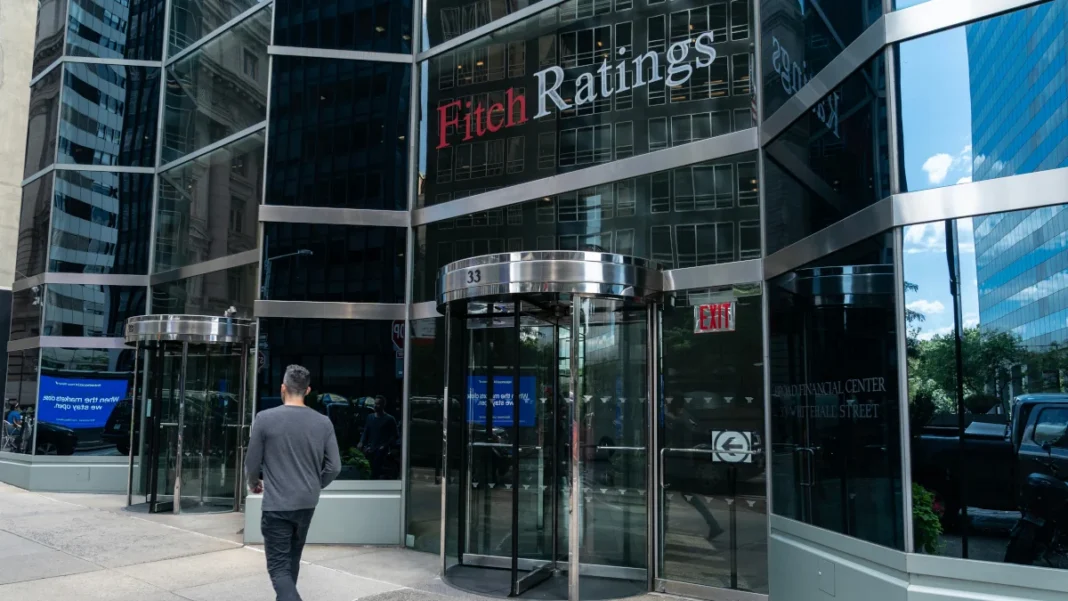
JOHANNESBURG, South Africa — South Africa faces renewed pressure over its public finances after Fitch Ratings warned that government debt could begin rising again in the 2028/29 financial year, challenging National Treasury’s projections and raising questions about whether Africa’s most industrialised economy can sustain its fiscal recovery without stronger economic growth.
By The Zimbabwe Financial Mail Economics Correspondent
The international credit ratings agency expects government debt to reach approximately 79% of gross domestic product in the financial year ending March 2029, reversing an anticipated period of stabilisation.
The forecast contrasts with the government’s expectation that debt has already reached its peak and will decline gradually over the medium term.
Fitch’s assessment also differs from that of Moody’s Ratings, which has expressed greater confidence in South Africa’s fiscal consolidation programme.
The disagreement highlights a fundamental economic challenge confronting Pretoria: whether improvements in revenue collection, spending discipline and fiscal management can sustainably reduce the country’s debt burden while economic growth remains subdued.
Fitch said it still expected government debt to stabilise at approximately 78% of GDP over the next two financial years, an assessment that supported its decision in June to upgrade South Africa’s sovereign credit rating to BB, with a stable outlook.
However, the agency warned that the improvement might not be sustained.
“Nevertheless, unlike the government, we expect debt to GDP to very modestly rise again,” Fitch said, projecting a ratio of 79% in 2028/29.
The warning follows Finance Minister Enoch Godongwana’s medium-term budget statement, in which the government projected a gradual reduction in public debt over the coming years.
Treasury Predicts Declining Debt Burden
Godongwana told lawmakers that government debt was expected to peak at 78.4% of GDP in the 2025/26 financial year before declining to 76.6% by 2029/30.
The projections form part of National Treasury’s broader strategy to stabilise public finances, contain borrowing requirements and reduce the share of government revenue absorbed by debt-service costs.
South Africa has spent years grappling with a combination of weak economic growth, persistent fiscal deficits, rising borrowing costs and financial pressures associated with state-owned enterprises.
These challenges have constrained the government’s ability to expand public investment while maintaining existing commitments to social services, infrastructure and public-sector expenditure.
Treasury’s projections suggest that improved fiscal discipline, alongside a gradual recovery in economic activity, could begin reversing the long-term increase in the public debt ratio.
Fitch is less convinced.
Its central concern is that economic growth may remain insufficient to generate the expansion in national income required to reduce the debt burden on a sustained basis.
This distinction is important because the debt-to-GDP ratio measures government debt relative to the size of the economy, rather than debt in isolation.
Even where borrowing is brought under greater control, weak growth can prevent the ratio from declining meaningfully.
Conversely, stronger nominal GDP growth can help reduce the relative debt burden by expanding the economic base against which outstanding liabilities are measured.
South Africa’s fiscal outlook therefore depends not only on budgetary restraint but also on the performance of the wider economy.
Moody’s Takes a More Optimistic View
Moody’s Ratings has adopted a more favourable assessment of South Africa’s fiscal trajectory.
The agency said the government’s latest budget update was credit-positive because it demonstrated that fiscal consolidation remained broadly on track despite difficult economic conditions.
Moody’s expects government debt to follow a gradual downward path after reaching its peak in the previous financial year.
It described the projected movement as a “clear, albeit gradual” decline.
The agency’s assessment is notable because its debt measure incorporates most government guarantees to state-owned enterprises, making its analysis broader in certain respects than a narrower measure of central government obligations.
Moody’s said the budget update demonstrated continued fiscal discipline despite higher oil prices, tighter monetary conditions and weaker nominal GDP growth than had been anticipated earlier in the year.
However, the agency cautioned that South Africa retained limited fiscal capacity to absorb unexpected economic shocks.
That qualification is significant.
An economy with high debt, substantial debt-service obligations and relatively weak growth has less room to respond to adverse developments without increasing borrowing, raising taxes or reducing expenditure elsewhere.
Potential pressures include weaker commodity prices, unexpected spending requirements, financing difficulties at public enterprises and slower-than-anticipated revenue growth.
Moody’s currently rates South Africa two notches below investment grade, with a positive outlook.
Fitch also places the sovereign two notches below investment grade, although its outlook is stable.
The difference in outlooks reflects contrasting assessments of the likelihood of further improvement in South Africa’s creditworthiness.
Why Economic Growth Matters More Than the Debt Forecast Alone
The disagreement between Fitch and Treasury is relatively modest in percentage terms, but it raises a larger question about South Africa’s economic model.
A debt ratio of 79% compared with 76.6% may appear to represent a limited difference.
However, even small changes in the debt trajectory can have significant implications for borrowing requirements, interest costs and investor perceptions when applied to an economy of South Africa’s size.
The fundamental issue is whether the government can achieve sufficient economic growth to support its fiscal consolidation objectives.
Debt sustainability is influenced by several interconnected factors: the government’s primary fiscal balance, the average interest rate on outstanding debt and the rate of nominal economic growth.
When borrowing costs remain elevated relative to economic growth, governments may need to generate stronger primary budget surpluses merely to stabilise their debt ratios.
That can create difficult policy trade-offs.
Higher taxes may support revenue collection but can constrain household consumption and private investment.
Reduced expenditure may improve the fiscal balance but can weaken public services or delay infrastructure investment if spending reductions are poorly targeted.
Increased borrowing may finance productive infrastructure, but it can also add to future debt-service obligations.
The challenge is therefore to improve the quality of public spending while creating conditions for stronger private-sector investment and productivity growth.
For South Africa, this places electricity reliability, freight logistics, infrastructure maintenance, business confidence and investment competitiveness at the centre of the fiscal debate.
Debt Sustainability and the Cost of Capital
Sovereign credit ratings influence how international investors assess a country’s capacity and willingness to meet its financial obligations.
Although ratings do not determine borrowing costs on their own, they can affect investment mandates, perceptions of credit risk and the compensation investors demand for holding government securities.
A sustained improvement in South Africa’s fiscal outlook could support investor confidence and reduce pressure on borrowing costs.
Conversely, evidence that debt is rising faster than expected could raise concerns about the government’s ability to contain future financing requirements.
The implications extend beyond the public sector.
Government borrowing costs often serve as a benchmark for domestic corporate financing.
When sovereign yields are elevated, banks and institutional investors may demand higher returns from private borrowers, increasing the cost of financing business expansion.
This can discourage investment in manufacturing, logistics, infrastructure and other productive activities.
The relationship is particularly important in an economy where private investment is needed to improve productivity and employment.
South Africa’s fiscal consolidation programme must therefore be judged not only by its effect on the government’s balance sheet but also by whether it helps create a more favourable environment for private capital formation.
State-Owned Enterprises Remain a Fiscal Risk
South Africa’s state-owned enterprises remain an important consideration in assessments of sovereign creditworthiness.
Financially distressed public entities can create direct and indirect obligations for government, particularly where they depend on state guarantees, financial support or capital injections.
The treatment of these obligations can differ across credit ratings methodologies.
Moody’s inclusion of most government guarantees to state-owned enterprises in its debt measure reflects the importance of assessing potential public liabilities beyond conventional budgetary borrowing.
The wider economic implications are equally important.
Electricity generation, rail transport, ports and other infrastructure services affect the competitiveness of South African businesses.
Weak operational performance can increase production costs, disrupt supply chains and discourage investment.
Consequently, reforms that improve the financial and operational performance of infrastructure-related public enterprises may support fiscal sustainability through more than one channel.
They can reduce potential demands on government finances while improving productivity and economic growth.
That combination would strengthen the foundations of debt stabilisation more effectively than expenditure restraint alone.
Regional Implications for Southern Africa
South Africa’s fiscal outlook also carries implications beyond its borders.
As a major regional centre for banking, manufacturing, logistics, retail and investment, the country plays a significant role in Southern Africa’s economic activity.
Zimbabwe, Botswana, Mozambique, Namibia, Zambia and other neighbouring economies maintain important commercial relationships with South African businesses and financial institutions.
Weak growth in South Africa can affect regional demand, investment decisions, transport activity and cross-border trade.
For Zimbabwe, the relationship is particularly important because South Africa is a major trading partner and an important source of manufactured goods, financial services and commercial investment.
A prolonged period of weak South African growth could constrain opportunities for Zimbabwean exporters seeking access to regional markets.
At the same time, fiscal and infrastructure reforms that strengthen South Africa’s economy could support regional supply chains and improve the commercial environment for neighbouring countries.
The broader lesson is that economic integration creates both opportunities and shared vulnerabilities.
Southern African economies would benefit from stronger regional manufacturing capacity, diversified trade relationships and more resilient investment networks rather than excessive dependence on the economic performance of a single market.
Investors Await the Next Ratings Decisions
Investors will now focus on the next scheduled sovereign rating reviews for indications of how the agencies assess South Africa’s fiscal and economic outlook.
Moody’s next review is expected on November 27, followed by Fitch on December 11.
Those assessments will provide further insight into whether the government’s fiscal consolidation programme is gaining sufficient credibility to support additional improvements in South Africa’s sovereign credit profile.
The agencies are likely to examine developments in economic growth, government revenue, expenditure management, debt-service costs and the financial risks associated with state-owned enterprises.
For National Treasury, the immediate challenge is to demonstrate that its projected decline in debt is achievable under realistic economic assumptions.
For investors, the key issue is whether fiscal consolidation can continue without undermining the investment and growth required to make the debt burden more sustainable.
The contrast between Fitch and Moody’s suggests that South Africa has made progress in stabilising its public finances, but has not yet eliminated the structural weaknesses that contributed to the accumulation of debt.
Outlook: Fiscal Discipline Must Be Matched by Growth
South Africa’s debt debate has moved beyond the question of whether government borrowing can be stabilised in the near term.
The more demanding test is whether the country can sustain a downward debt trajectory while financing essential public services, improving infrastructure and supporting economic expansion.
Fitch’s forecast suggests that current growth expectations may not be sufficient to guarantee that outcome.
Moody’s more optimistic assessment indicates that recent fiscal measures have nevertheless strengthened confidence in the government’s direction.
Both perspectives point to the same underlying economic requirement: stronger and more durable growth.
Without improvements in productivity, investment and the performance of key infrastructure sectors, fiscal consolidation may remain vulnerable to relatively modest economic shocks.
South Africa has made progress in restoring credibility to its public finances, but the country’s long-term credit outlook will depend on whether that progress is accompanied by a meaningful improvement in economic performance.
For Pretoria, the decisive challenge is no longer simply to demonstrate that government debt has peaked. It is to build an economy capable of ensuring that it continues to fall.