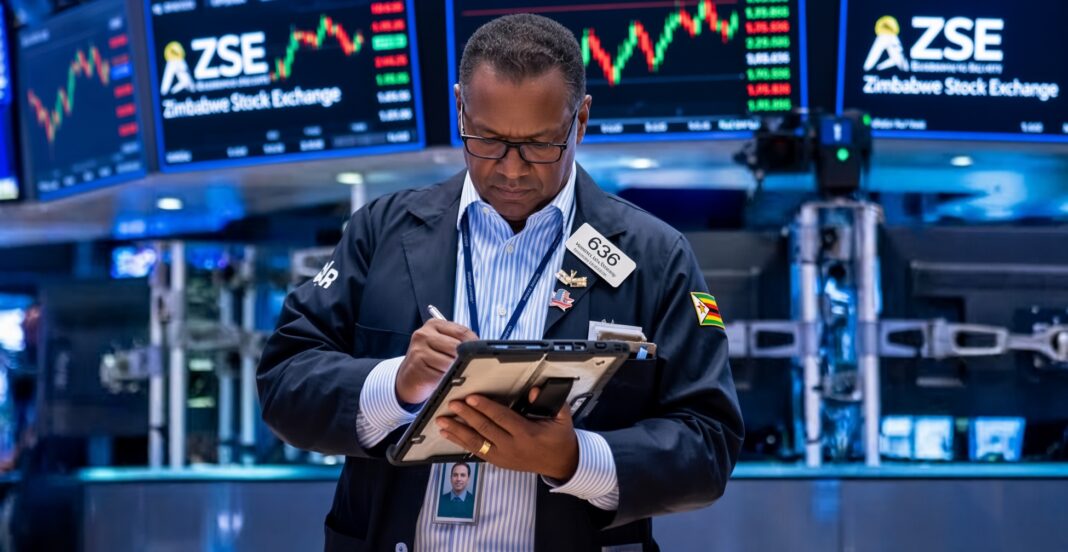
HARARE, October 2, 2026 — Zimbabwe’s equity markets delivered a sharply divergent performance on Friday, with the Zimbabwe Stock Exchange (ZSE) retreating modestly as financial stocks weakened, while the US-dollar-denominated Victoria Falls Stock Exchange (VFEX) rallied strongly on a surge in trading activity.
The ZSE All Share Index fell 0.44% to 480.19 points, extending a mixed week for local equities, while the ZSE Top 10 Index declined 0.55% and the Top 15 Index lost 0.55%.
Trading remained concentrated, with 68 trades generating ZWG18.66 million in turnover. The exchange’s total market capitalisation increased to ZWG107.51 billion, reflecting continued valuation gains in selected counters despite the day’s softer headline indices.
Market analysts who spoke to The Zimbabwe Financial Mail said the session illustrated the increasingly selective nature of Zimbabwean equity investment, with investors rotating between companies according to earnings expectations, liquidity and sector-specific developments rather than taking broad positions across the market.
“The market is showing a clear preference for counters where investors can identify a specific earnings or corporate catalyst. The broad index movement is therefore becoming less representative of individual investor performance,” one market analyst said.
Another analyst said the divergence between the ZSE and VFEX remained important for investors assessing Zimbabwe’s evolving capital-market structure.
“The VFEX provides a different proposition because investors are dealing in US dollars. The sharp increase in turnover there suggests that dollar liquidity and access to hard-currency assets remain important considerations for portfolio allocation,” the analyst said.
BAT, ARIS lead ZSE gainers
British American Tobacco Zimbabwe (BAT) was the day’s strongest gainer, rising 15% to 16,675 cents, while Ariston Holdings (ARIS) gained 5.48% to 9.47 cents.
Seed Co (SEED) rose 8.54% to 392.30 cents, while RTG advanced 12.54% to 140 cents. GB Holdings (GBH) added 0.81% to 9.90 cents.
The gains helped support the agriculture and consumer-related segments of the market, with the ZSE Agriculture Index rising 0.81% and the Consumer Discretionary Index jumping 12.54%.
The financial sector, however, remained under pressure. The Financials Index fell 2.27%, with NMB Holdings down 9.38% to 589.02 cents and Zimre Holdings (ZIMR) falling 8.67% to 70.33 cents.
CBZ Holdings declined 2.71%, while SACL slipped 2.49%.
The weakness in financial counters comes against a broader transition in Zimbabwe’s monetary and financial system, where investors continue to assess the interaction between the ZiG, US-dollar liquidity, interest rates and corporate earnings.
VFEX bucks the trend
The stronger performance came on VFEX, where the All Share Index gained 1.47% to 272.85 points.
More striking was the increase in market activity. VFEX recorded 269 trades and US$40.78 million in turnover, taking total market capitalisation to approximately US$8.39 billion.
The turnover was highly significant relative to recent daily activity and reinforces the importance of VFEX as Zimbabwe’s principal exchange for US-dollar-denominated equity exposure.
Despite the index gain, the counters listed in the day’s market snapshot were predominantly lower. Infrastructural Development Bank-linked counter INFR fell 1.39%, while Kavango (KAV) declined 0.80%. Old Mutual (OMU) slipped 0.78%, TSL fell 0.56% and Innscor Africa (INN) eased 0.53%.
The contrasting movements suggest that index performance was influenced by the composition and weighting of individual counters rather than a uniformly positive session.
Investors watch corporate earnings
The market is also entering an increasingly important corporate reporting period.
VFEX-listed Innscor Africa published its FY26 financial results earlier in the week, while INFR released unaudited half-year results on Friday. Other recent announcements include results from Simbisa Brands and financial disclosures from Zimplow.
On the ZSE, First Mutual Holdings (FML) published half-year US-dollar financial statements, while FIDELITY Life Assurance Zimbabwe and Zimbabwe Reinsurance Company announced appointments of group company secretaries and governance executives.
These disclosures are giving investors more earnings information against which to value companies as Zimbabwe’s capital markets increasingly operate across both local-currency and US-dollar environments.
For Zimbabwean businesses, the distinction is particularly important. Companies generating significant foreign-currency revenue can provide investors with a degree of protection against local-currency volatility, while businesses dependent heavily on domestic purchasing power remain more exposed to changes in inflation, exchange rates and consumer demand.
Zimbabwe’s two-market system
The widening role of VFEX is also consistent with Zimbabwe’s broader effort to deepen formal capital markets and attract foreign investment.
The exchange was established as a US-dollar-denominated market to provide companies with access to hard-currency capital and investors with an avenue for dollar-based portfolio investment. The ZSE, meanwhile, continues to provide the country’s principal domestic equity market.
Analysts said the coexistence of the two exchanges increasingly gives investors a choice between local-currency exposure and direct US-dollar exposure, although liquidity remains a key consideration on both markets.
“The development investors want to see is not simply higher index levels, but deeper liquidity, more listings, stronger institutional participation and a greater connection between listed companies and productive investment,” one analyst said.
That issue remains central to Zimbabwe’s financial-market reforms. As the economy seeks to move more activity into formal channels, deeper capital markets could provide companies with an alternative to short-term bank borrowing while giving pension funds, insurers and individual investors greater access to productive assets.
For Friday’s session, however, the message was one of selectivity rather than a broad market rally: the ZSE softened despite gains in several industrial and consumer counters, while VFEX posted a stronger index performance amid exceptionally high dollar turnover.