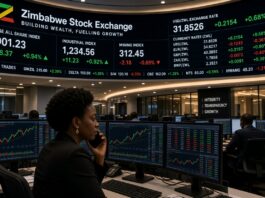
HARARE – Zimbabwean equities extended their losses on Thursday as renewed selling pressure in heavyweight banking stocks dragged the Zimbabwe Stock Exchange (ZSE) lower, while the Victoria Falls Stock Exchange (VFEX) recorded a sharp increase in trading activity despite a modest decline in its benchmark index.
The ZSE All Share Index fell 0.50 percent to 487.23 points on October 29, extending the previous session’s decline, as investors continued to reduce exposure to selected large-capitalisation counters.
Market capitalisation stood at ZWG112.41 billion, compared with ZWG113.11 billion in the preceding session, representing a contraction of approximately ZWG696 million.
Trading activity remained subdued, with 63 transactions generating turnover of ZWG26.12 million, highlighting the relatively narrow liquidity conditions confronting Zimbabwe’s domestic equities market.
CBZ Holdings emerged as the session’s biggest heavyweight casualty, declining 6.66 percent to ZWG28.0017 per share, following a 6.25 percent retreat on Wednesday.
The banking group’s consecutive losses placed additional pressure on the financial sector, whose index fell 2.47 percent to 483.62 points.
The ZSE Top 10 Index declined 0.66 percent to 479.64 points, while the Top 15 Index lost 0.64 percent, suggesting that selling pressure remained concentrated among the exchange’s larger companies.
The weakness in financial stocks contrasted with gains in selected industrial and agricultural counters, reflecting an increasingly differentiated market in which investors appear to be reassessing individual company valuations rather than selling indiscriminately.
Turnall Industries led the day’s gainers, surging 15 percent to 13.80 ZiG cents, followed by Hippo Valley Estates, which advanced 10.38 percent to 1,104.38 cents.
First Mutual Holdings gained 7.76 percent, while British American Tobacco Zimbabwe rose 5.06 percent.
The materials sector delivered the strongest sectoral performance, climbing 7.05 percent, while the agriculture index gained 2.85 percent.
Ariston Holdings declined 5.40 percent, Zimre Holdings fell 3.42 percent and Delta Corporation eased 0.17 percent.
The divergent movements illustrate a market increasingly influenced by stock-specific developments, thin trading volumes and changing expectations about corporate earnings.
On the US dollar-denominated VFEX, the All Share Index slipped 0.28 percent to 274.30 points, even as turnover reached US$1.50 million across 225 transactions.
The turnover represented a substantial increase from Wednesday’s US$516,464, indicating stronger trading activity despite the softer benchmark.
VFEX market capitalisation rose to US$9.09 billion from approximately US$9.05 billion in the previous session, suggesting that changes in the value of listed securities were not entirely reflected in the headline index movement.
WestProp Holdings recorded the steepest decline among the counters highlighted in the market report, falling 16.93 percent to US$0.2791.
Invictus Energy dropped 6.86 percent to US$0.1304, while Padenga Holdings lost 6.02 percent to US$1.5006.
African Sun-linked Eagle Real Estate Investment Trust declined 4.46 percent, while Econet InfraCo eased 2.10 percent.
Invictus Energy also featured in the day’s corporate announcements after reporting progress in preparations for drilling at its Musuma-1 prospect, including completion of the rig move.
For investors, the contrast between the two exchanges remains significant.
The ZSE continues to provide exposure to Zimbabwe-dollar-denominated equities, while the VFEX offers US dollar trading and investment opportunities for companies seeking access to foreign-currency capital.
However, analysts generally distinguish between the currency in which securities are traded and the underlying commercial risks of the businesses themselves. A US dollar quotation does not automatically protect investors from earnings volatility, weak liquidity or declining share prices.
Thursday’s performance underscored that distinction, with VFEX turnover strengthening even as several prominent counters recorded substantial losses.
For the broader Zimbabwean equity market, the immediate question is whether improved corporate earnings and greater trading liquidity can restore momentum after consecutive sessions of weakness in the main benchmarks.
The answer will depend increasingly on company fundamentals, investor confidence and the capacity of both exchanges to attract sustained institutional participation.