HARARE – Zimbabwe’s equities market delivered sharply contrasting performances on Friday, with the Zimbabwe Stock Exchange (ZSE) retreating across its main indices while the US dollar-denominated Victoria Falls Stock Exchange (VFEX) advanced, highlighting continued divergence between the country’s two equity markets.
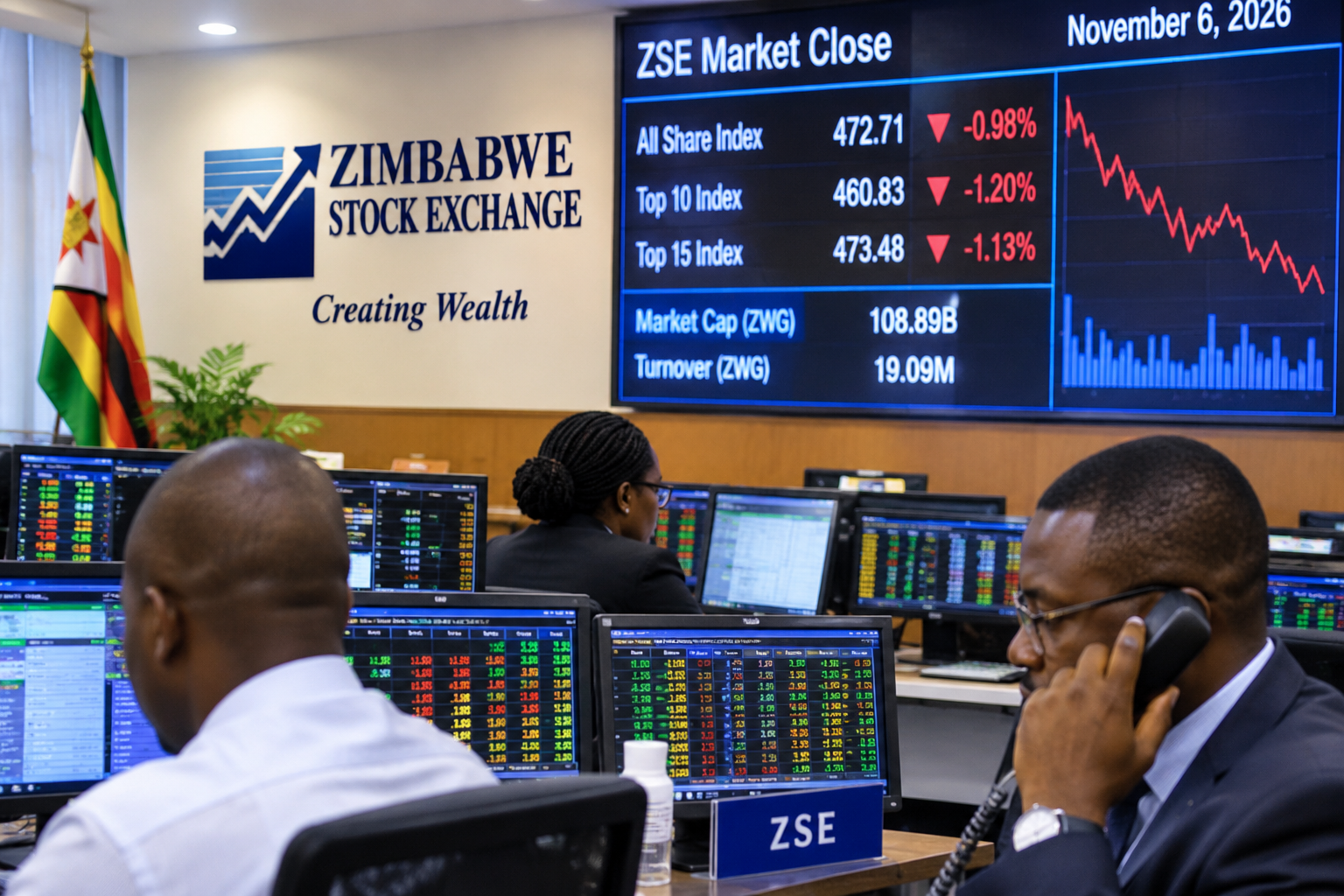
The ZSE All Share Index fell 0.98% to 472.71 points, while the Top 10 declined 1.20% to 460.83 and the Top 15 shed 1.13% to 473.48. The market recorded 90 trades worth ZWG19.09 million, with total capitalisation at ZWG108.89 billion.
FBC Holdings was the session’s biggest faller, dropping 10.73% to 1,000 cents. Hippo Valley Estates lost 8.84% to 911.58 cents, while Proplastics declined 4.58%, Seed Co shed 3.15% and Delta Corporation fell 1.18%.
The losses were partly offset by Ariston Holdings, which rose 14.20% to 13 cents. CBZ Holdings gained 3.12% to 2,999.95 cents, while SACL advanced 2.54%. Tanganda and GetBucks recorded marginal gains.
Sector performance reflected the broader weakness. The modified consumer staples index fell 1.29%, materials declined 1.19%, agriculture lost 1.13% and financials dropped 1.03%. The consumer staples index shed 1.10%, while the real estate index eased 0.20%. The Zim National Index was among the few positive performers, rising 0.91%.
The VFEX moved in the opposite direction, with its All Share Index gaining 2.09% to 273.65 points. The exchange recorded 149 trades worth US$88,592.64, while market capitalisation stood at approximately US$9.06 billion.
Simbisa Brands led the reported VFEX gainers, rising 7.39% to US$0.7007. NEDBANK advanced 6.25% to US$17, while FMWG gained 6.17%. Innscor rose 5.93% to US$1.6159 and KAV added 4.48%.
The contrasting performance comes amid wider questions about the depth and competitiveness of Zimbabwe’s capital markets. In an October 30 commentary published by NewZwire, international investor Ritesh Anand argued that the ZSE’s long-term recovery requires reforms addressing liquidity, trading costs, investor confidence and the ability of companies to raise fresh capital. He wrote: “Stability is the precondition for a revival. It is not proof of one.”
Anand’s argument provides a broader structural context for Friday’s trading, although his commentary was not a direct assessment of the latest session.
The assessment of analysts who spoke to The Zimbabwe Mail said the divergent index movements underline the importance of improving liquidity and broadening investor participation across both exchanges.
The latest session also featured corporate announcements, including a dividend notice from Tigere Real Estate Investment Trust and a board appointment notice from Delta Corporation. Such disclosures remain important to investors assessing corporate governance, shareholder returns and listed-company performance.
While the VFEX recorded stronger index performance, its turnover should not be directly compared with ZSE turnover without accounting for the different trading currencies. The two exchanges nevertheless illustrate the choices facing investors in a market where currency denomination, liquidity and transaction costs remain central to capital allocation.