





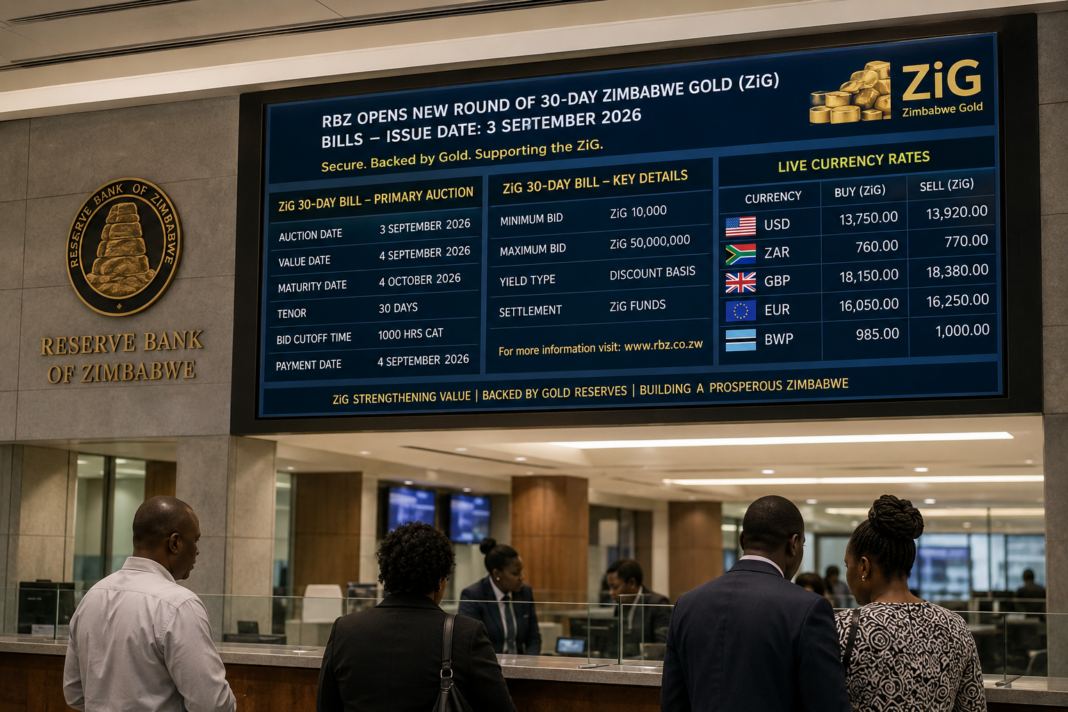
HARARE — The Reserve Bank of Zimbabwe (RBZ) has opened a new round of 30-day Zimbabwe Gold (ZiG) Denominated Term Deposit Facility Bills, signalling a continued shift towards market-based liquidity management and the development of a deeper domestic financial market for the local currency.
The central bank said the ZiGDTDF is an open-market operations instrument designed to support the stability of the ZiG while encouraging a stronger savings culture. The latest offer opened on September 3 and closes on September 9, with settlement and issuance scheduled for the same day.
According to the RBZ, the 30-day instrument carries an annual interest rate of 8%, with subscriptions open to banks, corporates, individuals, insurance and pension funds, POSB and deposit-taking microfinance institutions. The minimum subscription is ZiG10 million for financial institutions, ZiG500,000 for corporates and ZiG100,000 for individuals.
The central bank described the instrument as part of its Open Market Operations toolkit, intended not only to manage liquidity but also to strengthen confidence in ZiG-denominated financial assets.
“The financial instrument offers attractive opportunities for positive real interest rate investments and is an integral component of the RBZ’s Open Market Operations toolkit,” the central bank said.
The significance of the facility extends beyond its immediate investment return. It represents an attempt by monetary authorities to build the financial infrastructure required for a functioning local-currency market, particularly by establishing instruments through which savings, liquidity and interest rates can be priced in ZiG.
The RBZ said the facility aligns with the 2026 Monetary Policy Statement’s emphasis on paying real interest rates to depositors, maintaining exchange-rate stability, adopting market-based liquidity management and strengthening confidence in ZiG-denominated assets.
The latest 30-day offering follows the central bank’s earlier introduction of the ZiGDTDF programme. In May, RBZ Governor John Mushayavanhu said the instrument was intended to complement the bank’s Negotiable Certificates of Deposit open-market operations framework.
“This is the OMO instrument we announced in the February Monetary Policy Statement. It will complement the NNCD,” Mushayavanhu said at the time.
He said one of the central objectives was to encourage economic agents to begin treating ZiG as a store of value, while another was to establish a yield curve for the domestic currency.
For Zimbabwe’s banking system, the development of such a yield curve could become increasingly important. A credible curve provides a reference for pricing deposits, loans and other financial assets and can ultimately help establish a more sophisticated domestic capital market.
The facility also has several features designed to make it attractive to institutional investors. The bills have prescribed-asset and liquid-asset status, can be used as collateral for accommodation from the RBZ, are redeemable at the central bank at maturity and are tradable.
From a monetary-policy perspective, the instrument gives the central bank another mechanism through which it can influence the quantity and price of liquidity in the banking system. Instead of relying exclusively on conventional policy-rate adjustments, the RBZ can use securities and deposit facilities to absorb surplus liquidity and influence financial-market behaviour.
The approach is particularly relevant to Zimbabwe’s broader currency-reform challenge. Restoring confidence in a domestic currency requires more than simply introducing banknotes or establishing a legal tender framework. It requires the creation of financial assets denominated in that currency, credible returns for savers, functioning money markets and mechanisms through which monetary policy can be transmitted to the wider economy.
The RBZ’s latest offering therefore represents a step towards creating a domestic financial architecture around the ZiG rather than treating the currency merely as a medium of exchange.
The central bank has also positioned the facility as a savings instrument capable of delivering positive real returns. That objective is significant in an economy where households and businesses have historically had strong incentives to preserve savings in foreign currency or physical assets.
For the banking sector, the emergence of a central-bank-backed ZiG investment instrument also potentially creates a benchmark against which commercial banks will have to price their own ZiG deposits and savings products.
The RBZ said the ZiGDTDF was introduced under the 2026 Monetary Policy Statement specifically to “uphold the stability” of the local currency and promote savings.
The broader policy question, however, will be whether the creation of increasingly sophisticated ZiG financial instruments can translate into sustained confidence in the currency.
For currency reform to succeed, analysts say, savers ultimately need to believe that the return earned on a ZiG asset will compensate adequately for both inflation and exchange-rate risk. The effectiveness of the instrument will therefore depend not simply on its headline 8% interest rate, but on the stability of the purchasing power and external value of the currency over the investment period.
The RBZ’s latest move suggests that Zimbabwe’s currency reform is increasingly moving from the introduction of the ZiG towards the construction of a financial market around it.
That transition — from currency issuance to financial-market development — could prove considerably more important for the long-term credibility of the ZiG than the introduction of the currency itself.


