





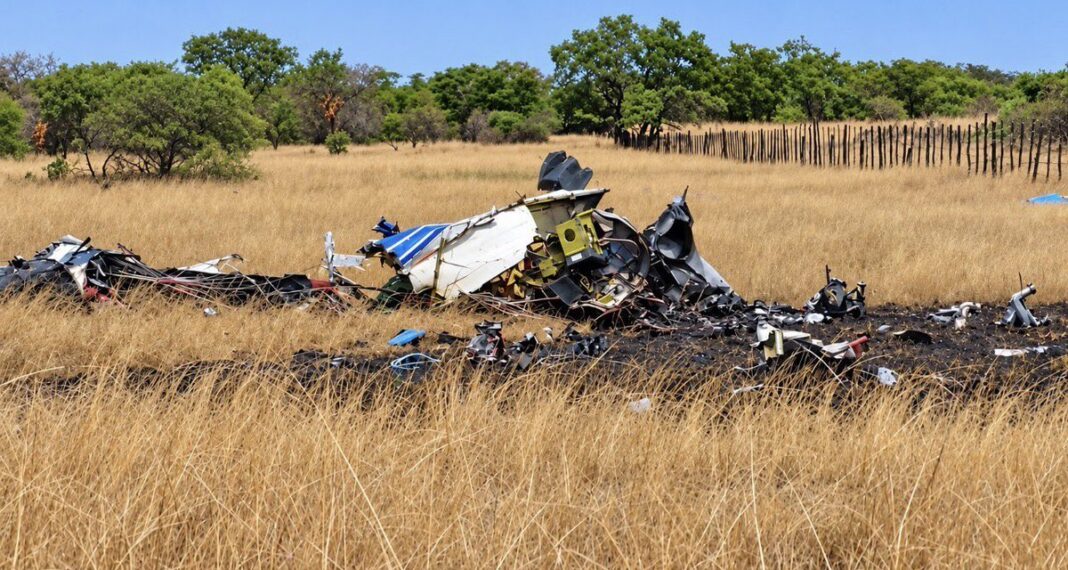
HARARE — Prominent Zimbabwean businessman Wicknell Chivayo and his wife, Lucy Muteke, were among six people killed when a helicopter crashed in Marondera on Wednesday evening, bringing an abrupt end to the life of one of the country’s most visible and controversial entrepreneurs.
The helicopter came down in the Marondera Rural area of Mashonaland East at about 5pm, according to the Zimbabwe Republic Police. Government confirmed that there were no survivors.
Chivayo’s family subsequently confirmed his death, with family spokesperson Herbert Chivayo telling national broadcaster ZBC that the businessman and his wife were among those killed.
The identities of the remaining victims were still being formally established as investigators examined the crash site.
The cause of the accident had not been established.
From Intratrek to a high-profile business empire
Chivayo, who was in his early forties, built his public profile through Intratrek Zimbabwe, with interests centred particularly on energy and infrastructure.
His most closely watched commercial project was the 100MW Gwanda solar project, awarded to Intratrek by the Zimbabwe Power Company. The project became embroiled in a prolonged dispute over delays and the contract’s status, before September developments put it back on the government’s implementation agenda.
According to recent reporting, Intratrek had been preparing to resume work on the project following a Notice to Proceed, with the revised project cost reported at below US$132 million.
That development immediately gives Chivayo’s death a commercial dimension for Zimbabwe’s energy sector.
Analysts who spoke to The Zimbabwe Financial Mail said the immediate issue would be continuity of management and ownership across his business interests rather than any assumption that existing projects would automatically terminate.
“The death of a principal shareholder or founder does not by itself determine the future of a company,” one Harare-based corporate analyst said. “The important questions will be the ownership structure, succession arrangements, existing contractual obligations and the capacity of management to continue executing projects.”
Another analyst said the Gwanda project would be particularly important because of its strategic significance to Zimbabwe’s electricity supply.
“Zimbabwe needs generation capacity irrespective of who owns the contractor,” the analyst told The Zimbabwe Financial Mail. “The commercial question is whether the project can proceed under its existing contractual and financing arrangements and whether the company has sufficient institutional depth beyond its founder.”
A businessman who divided opinion
Chivayo became one of Zimbabwe’s most recognisable wealthy entrepreneurs, combining business interests with an unusually prominent social-media presence and highly publicised philanthropy.
He regularly publicised donations to churches, sports personalities, musicians and other public figures, including large cash contributions and luxury vehicles.


His conspicuous displays of wealth made him a celebrity figure in Zimbabwe, while his proximity to senior political figures generated sustained public debate about the relationship between business, government contracts and political influence.
He was also frequently photographed with regional leaders, including Kenyan President William Ruto and Eswatini’s King Mswati III. President Ruto has since publicly mourned Chivayo, describing him as a friend.
“Chivayo represented a particular model of Zimbabwean entrepreneurship — highly visible, politically connected and heavily concentrated around major transactions,” a second business analyst told The Zimbabwe Financial Mail. “His death will inevitably raise questions about succession, corporate governance and the institutionalisation of businesses built around prominent individuals.”
Procurement controversies followed his rise
Chivayo’s business career was also marked by controversy.
His companies secured major government-linked contracts, including a contract associated with the supply of election materials ahead of Zimbabwe’s 2023 general elections. His business dealings subsequently became the subject of political and legal controversy.
Chivayo also became embroiled in a dispute with businessmen Moses Mpofu and Mike Chimombe over a government tender, with the two later convicted in a separate fraud case. Chivayo had denied wrongdoing.
His political relationships became part of the public debate around Zimbabwe’s emerging wealthy business class, particularly amid criticism over the awarding of state contracts and the concentration of economic opportunities among politically connected entrepreneurs.
Analysts cautioned, however, against allowing those controversies to obscure the more immediate commercial questions arising from his death.
“Whatever one’s view of Chivayo’s public profile, there are businesses, employees, contracts and counterparties that now require continuity,” the first analyst said. “That is a corporate governance issue rather than simply a political story.”
Succession could become the next major issue
The death comes at a sensitive point for Zimbabwe’s economy, as the country seeks to mobilise private capital into power generation, infrastructure, mining and other productive sectors.
For investors and commercial counterparties, the key question will be whether businesses associated with Chivayo can operate with less dependence on the founder.
Zimbabwe’s corporate sector has historically included a number of founder-led businesses, making succession planning increasingly important as private companies grow into significant employers and contractors.
“This tragedy illustrates why institutional governance matters in a developing economy,” the second analyst said. “A company that depends excessively on one individual for capital, political relationships, strategic decisions and execution carries a different risk profile from one with a strong professional management and governance structure.”
Chivayo’s death therefore extends beyond the personal tragedy of losing a prominent businessman. It leaves a portfolio of commercial interests whose future will depend on ownership arrangements, management continuity, contractual obligations and the ability of those businesses to function without their founder.
For Zimbabwe’s energy sector, the immediate focus will be on whether major projects associated with Intratrek can continue. For the wider business community, the episode is a reminder that succession planning and institutional governance are becoming increasingly important as privately controlled enterprises take on larger roles in the economy.
The investigation into the Marondera crash is continuing, with authorities expected to provide further information on the circumstances of the accident and the remaining victims.


