





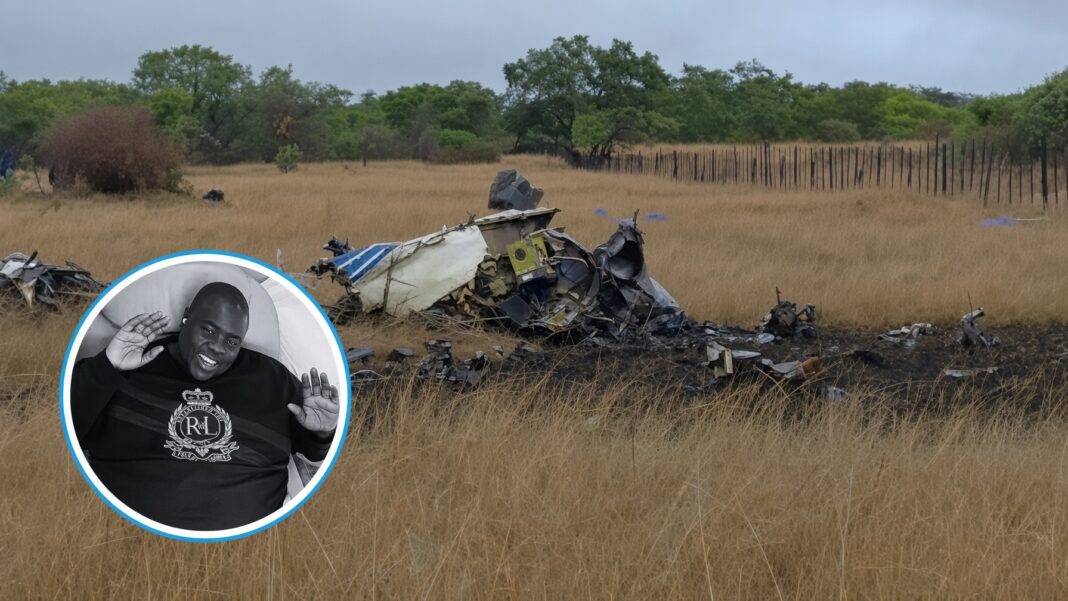
HARARE — The final minutes of the helicopter flight carrying businessman Wicknell Chivayo and his wife, Lucy Muteke, are coming under renewed scrutiny after an eyewitness account described deteriorating weather, repeated warnings from the pilot and a loss of radio communication shortly before the aircraft crashed at Kudenga Farm in Marondera.
The account was provided by Froster Chisi, a senior security aide travelling in a second helicopter accompanying Chivayo’s Bell 430 on September 30.
Chisi’s account offers a chronology of the flight, but it is not itself an aviation investigation finding. Authorities have said investigations into the cause of the crash remain ongoing. Civil Aviation Authority of Zimbabwe (CAAZ) director-general George Mashababe said preliminary observations showed that fuel spilt after impact and subsequently ignited.
The crash killed Chivayo, Muteke and the two pilots, according to the family account cited in the eyewitness testimony. Initial official reports differed on the number of occupants, with police initially reporting six people aboard the aircraft, while Chisi said five people were in the Bell 430.
Weather deteriorated on return flight
According to Chisi, the two helicopters left Harare at about 3 pm for Gandami, where Chivayo was inspecting construction work at his rural property.
The aircraft remained on the ground during the visit before departing at approximately 4.20 pm on the return journey.
The original plan was to travel towards Harare with a stop at Marondera.
Chisi said weather conditions deteriorated significantly during the return flight. The pilot of the second helicopter consequently proposed a diversion through Bromley to avoid the developing weather.
The pilot of Chivayo’s aircraft, meanwhile, reportedly entered the cloud.
Chisi said he heard the pilot repeatedly report difficult conditions, including the statement:
“I’m in bad weather, I haven’t exited the cloud.”
The aircraft subsequently reported its position around the Surrey area before communications deteriorated.
Final radio exchange
The most significant part of Chisi’s account concerns the final exchange between the two aircraft.
The pilot of the second helicopter reportedly told the Bell 430 crew that they were approximately 10 minutes from their destination.
Chisi said the pilot flying Chivayo then responded: “Which destination?”
The other pilot reportedly replied that the destination was Marondera.
There was no further response from the Bell 430.
The second helicopter subsequently landed at Marondera, where those aboard waited for Chivayo’s aircraft.
When it failed to arrive, the security team returned to Harare to mobilise vehicles and search personnel. Chisi said attempts were made for more than an hour to contact Chivayo, his wife and the flight crew before the crash was located.
A similar account of the final communications has subsequently been reported by several regional media outlets.
Investigation has not established cause
The sequence has prompted speculation about whether the aircraft encountered spatial disorientation in poor visibility, but such a conclusion would be premature until investigators examine the flight data, aircraft systems, weather information, pilot qualifications and operating procedures.
The CAAZ has not publicly established that spatial disorientation or a failure to operate under instrument flight rules caused the crash.
Mashababe has confirmed that the aircraft caught fire after the impact, with fuel spilling and subsequently igniting surrounding vegetation. He said investigators were still working to establish why the aircraft crashed.
The investigation will therefore need to distinguish between what happened after impact and what caused the aircraft to descend into the terrain in the first place.
That distinction is important because the post-impact fire does not, by itself, establish the cause of the crash.
Black box becomes key evidence
The recovery of the flight recorder could prove significant if the device is sufficiently intact to provide investigators with usable data.
Investigators are expected to examine the aircraft’s flight path, altitude, speed, heading and other available parameters alongside air-traffic records, weather conditions, maintenance documentation and witness testimony.
The account from the accompanying helicopter provides investigators with an unusually valuable external perspective because the two aircraft were operating on the same journey and remained in radio contact shortly before the accident.
However, aviation analysts caution that radio communications alone cannot establish what was happening inside the cockpit.
“The eyewitness account is important because it establishes the weather environment and the communications sequence, but investigators still need to reconstruct the aircraft’s actual flight path and cockpit decision-making from objective evidence,” an aviation source told The Zimbabwe Financial Mail.
Business community faces loss of prominent entrepreneur
Chivayo’s death has also created uncertainty around businesses and investments associated with one of Zimbabwe’s most prominent and controversial entrepreneurs.
The businessman was best known for Intratrek Zimbabwe and its involvement in major energy projects, including the long-delayed Gwanda solar project. His business interests and relationships extended beyond Zimbabwe, including announced energy ambitions in Eswatini.
His public profile was unusually intertwined with Zimbabwe’s business, political and social environment, making his death significant beyond the immediate tragedy.
For businesses associated with closely held entrepreneurial groups, succession, ownership structures, financing arrangements and operational continuity can become important considerations following the death of a principal shareholder or founder.
An analyst who spoke to The Zimbabwe Financial Mail said the immediate priority should nevertheless remain establishing the facts surrounding the accident.
“The commercial consequences will eventually have to be addressed through the relevant corporate and estate structures, but it is too early to speculate about ownership or succession. The priority now is the aviation investigation and the families of those who died,” the analyst said.
A tragedy now under formal investigation
The crash occurred approximately 70 kilometres east of Harare, with forensic and aviation investigators deployed to the site after the accident.
The deaths of Chivayo, Muteke and the other occupants have prompted widespread reaction across Zimbabwe and the region, reflecting the businessman’s unusually high public profile.
But the emerging timeline should not be treated as a final accident report.
What can currently be established is that the aircraft encountered deteriorating weather, the pilot reportedly communicated difficulties while in cloud, radio contact was subsequently lost, and the helicopter crashed shortly afterwards. CAAZ’s preliminary findings indicate that fuel spilt on impact and ignited.
The central unanswered question remains why the Bell 430 lost its safe flight path.
That answer will ultimately depend on the formal investigation, particularly the evidence from the aircraft’s flight recorder, air-traffic records, weather data and wreckage examination.


