


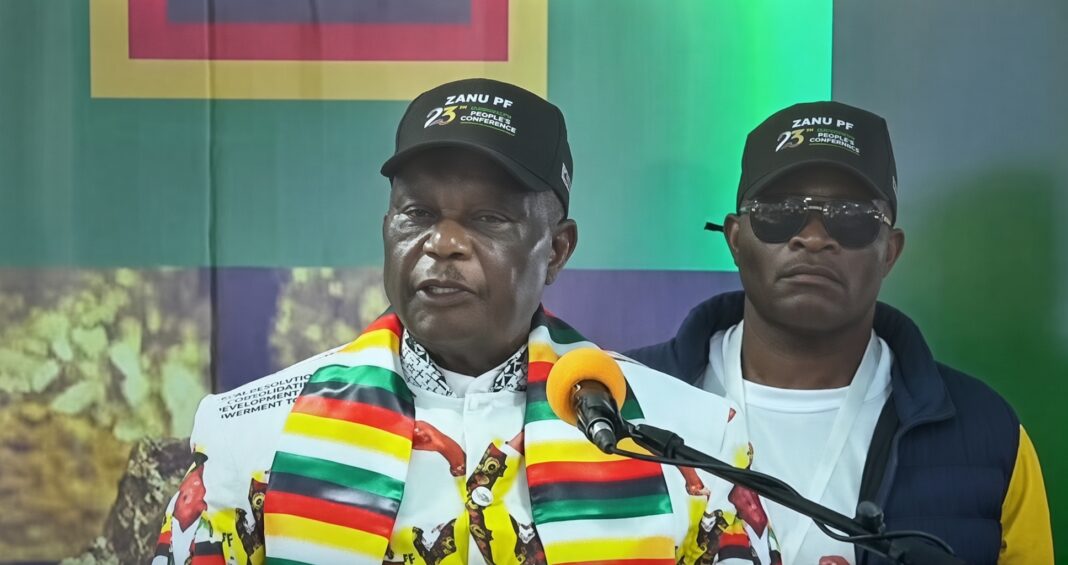
HARARE — Vice President Constantino Chiwenga delivered a blistering, thinly veiled rebuke to President Emmerson Mnangagwa at ZANU-PF’s annual conference in Chinhoyi on Friday, questioning whether the ruling party was repeating the political failures that precipitated Robert Mugabe’s removal in 2017, as an increasingly bitter succession struggle unfolds around businessman Kudakwashe Tagwirei.
In a speech loaded with political symbolism, Chiwenga challenged the party’s leadership over constitutional discipline, personal ambition and the concentration of political and economic power, insisting that ZANU-PF belonged to its membership rather than powerful individuals.
The intervention came barely 24 hours after Mnangagwa elevated Tagwirei to the party’s Politburo as Secretary for Economic Affairs and Investment Promotion, consolidating the businessman’s influence following his appointment as Minister of Economic Development and Investment Promotion.
Tagwirei’s accelerated rise through the party and government has fuelled speculation that Mnangagwa is positioning him as a potential successor, although the President has not publicly endorsed him for the presidency.
Chiwenga did not mention either Mnangagwa or Tagwirei by name. Nevertheless, the timing of his remarks, delivered against a backdrop of reported disagreements over constitutional amendments and leadership succession, gave his speech an unmistakably confrontational political significance.
Chiwenga invokes the failures that brought down Mugabe
The most explosive passage came when Chiwenga questioned the founding purpose of the Second Republic, which emerged following the military intervention that ended Mugabe’s 37-year rule.
Speaking in Shona, he asked: “Chii chakaita kuti Second Republic ivepo? Kwaive kugadzirisa zvakaipa zvanga zvichiitika kumashure. Hatisi kudzokorora here kuita zvatakambotadza?”
The Vice President was asking why the Second Republic had been established and whether the country was now repeating the mistakes it had promised to correct.
It was a politically loaded question from the former military commander whose intervention in November 2017 helped bring Mnangagwa to power.
Chiwenga’s remarks effectively turned the founding justification of Mnangagwa’s presidency into a test of the President’s current leadership.
The Second Republic had promised reform, institutional renewal, accountability and an end to the governance failures associated with Mugabe’s final years.
Nearly nine years later, Chiwenga was asking whether those promises had survived the consolidation of political power.
‘Our party belongs to the people, never to individuals’
The Vice President’s strongest constitutional warning concerned the ownership of political authority.
“Our party belongs to the people, never to individuals,” Chiwenga declared.
He insisted that the party’s decisions must reflect its membership and that leaders must remain accountable to those who entrusted them with political authority.
“Change must be driven by the people, not imposed from above,” he said.

The statement carries considerable significance amid reported efforts to amend ZANU-PF’s constitution and reshape its internal electoral arrangements.
Those discussions have become intertwined with the succession question and the future of Mnangagwa’s leadership.
Chiwenga’s insistence on grassroots authority appears to challenge the legitimacy of changes perceived to originate from the presidency rather than the party’s lower structures.
The Vice President also invoked the moral authority of public consent, reminding Mnangagwa that the people’s voice must remain central to political decision-making.
His message was that constitutional procedure cannot simply become an administrative instrument for accommodating the ambitions of powerful officeholders.
Political analyst warns of an explosive succession struggle
The confrontation echoes warnings previously made by Zimbabwean political scientist Professor Eldred Masunungure, who has cautioned that ZANU-PF’s internal divisions could threaten the party’s stability.
Speaking to The Zimbabwe Mail during the party’s October 2025 conference in Mutare, Masunungure warned:
“The long and short of it is that the Zanu PF pot is ‘overboiling’ and if not managed well, it may very well explode.”
His warning was made a year before the latest Chinhoyi confrontation, but the underlying concern about factional rivalry remains relevant.
Masunungure argued that the party’s leadership needed stronger mechanisms for managing internal disagreements to prevent a damaging political rupture.
The latest developments suggest that the succession question remains unresolved despite repeated public declarations of party unity.
Political commentator Washington Katema, writing in an October 13 analysis published by ZimLive, identified three possible outcomes from the current struggle: Mnangagwa’s allies securing constitutional changes, resistance forcing a compromise, or unresolved disagreements developing into a more serious institutional confrontation.
Katema’s analysis presents the conflict as a contest not merely over personalities but over who controls the party’s succession machinery and the rules through which future leadership is determined.
Neither analyst is being presented as having spoken to The Zimbabwe Mail about Friday’s speech.
Tagwirei becomes the new fault line
Tagwirei’s elevation has introduced a new dimension into the political rivalry between Mnangagwa and Chiwenga.
The businessman, who has substantial commercial interests, has moved rapidly into the highest levels of political decision-making.
His appointment to the newly created economic development and investment promotion ministry was followed by his elevation to ZANU-PF’s Politburo on Thursday.
The developments place him at the centre of both government economic policy and the ruling party’s economic strategy.
For Mnangagwa, Tagwirei’s commercial experience may offer an opportunity to strengthen the government’s investment and industrial development agenda.
But his expanding political influence has also generated questions about the relationship between business wealth, presidential patronage and political succession.
The central question is whether his rise reflects a conventional political appointment or a broader effort to reshape the balance of power within ZANU-PF.
There is no verified formal succession agreement naming Tagwirei as Mnangagwa’s preferred successor.
Nevertheless, the speed of his elevation has intensified perceptions that a new political power centre is emerging around the presidency.
For Chiwenga, long regarded as a potential successor following his central role in the 2017 transition, such a development could significantly alter the party’s leadership calculations.
Chiwenga attacks an economy benefiting the privileged few
The Vice President also delivered a pointed critique of economic inequality and the concentration of opportunity among powerful interests.
He argued that Zimbabwe’s development agenda must improve the lives of ordinary citizens rather than perpetuate their dependence on wealthy and politically influential individuals.
His warning against Zimbabweans becoming dependent on the “benevolence of the privileged few” was particularly striking amid the growing political influence of prominent business figures.
Although Chiwenga did not identify Tagwirei or any other businessman, the statement will inevitably be scrutinised in the context of the current debate about economic patronage.
The Vice President’s argument was that economic empowerment must create independent and prosperous citizens, not relationships of dependency between the politically powerful and the wider population.
That distinction carries implications for Zimbabwe’s development strategy.
The country has made progress towards lower inflation and greater exchange-rate predictability, while mining, agriculture and investment have supported economic recovery.
Yet the distribution of economic opportunity remains uneven.
Many Zimbabweans continue to depend on informal employment, small-scale trading and limited access to formal credit.
For businesses, genuine economic empowerment requires competitive markets, transparent procurement, affordable financing and a regulatory environment that does not privilege political connections over productive enterprise.
Chiwenga’s remarks therefore connected the succession dispute to a wider economic question: who ultimately benefits from the country’s recovery?
A battle over the meaning of the Second Republic
Chiwenga’s intervention is especially consequential because of his historical relationship with Mnangagwa.
The two men emerged as the principal beneficiaries of the political transition that ended Mugabe’s presidency.
Mnangagwa assumed the presidency while Chiwenga subsequently became Vice President, establishing a political partnership rooted in the events of November 2017.
However, that partnership has long carried an unresolved succession question.
The latest controversy over constitutional changes and Tagwirei’s advancement has brought the issue into sharper focus.
By questioning whether the Second Republic was repeating past mistakes, Chiwenga invoked the very political justification used to establish Mnangagwa’s administration.
His message suggested that the legitimacy of the 2017 transition must be measured against institutional conduct rather than simply the replacement of one president by another.
It also raised the uncomfortable possibility that the governing party’s internal struggle is becoming a contest over the historical meaning of the Second Republic itself.
Economic stability faces a political test
The deepening succession uncertainty comes at a sensitive moment for Zimbabwe’s economy.
The government is seeking to consolidate monetary stability, attract foreign investment and progress towards external debt arrears clearance.
Its engagement with the International Monetary Fund is intended to strengthen economic policy credibility and improve prospects for renewed international financing.
Political uncertainty could complicate that effort if it undermines confidence in institutional continuity and predictable policymaking.
Long-term investors in mining, energy, infrastructure and manufacturing require confidence that laws, contracts and investment frameworks will remain stable beyond individual political administrations.
Tagwirei’s new economic responsibilities also place questions of governance and potential conflicts of interest under greater scrutiny.
The credibility of his portfolio will depend on transparent decision-making, measurable investment outcomes and appropriate separation between public responsibilities and private commercial interests.
For Chiwenga, the broader argument appears to be that economic development cannot be separated from institutional integrity.
Succession battle enters a more dangerous phase
The Chinhoyi address has brought ZANU-PF’s internal tensions into unusually sharp public focus.
Chiwenga did not announce a leadership challenge or directly accuse Mnangagwa of manipulating the party constitution.
But his language represented a substantial political warning.
He questioned whether the governing establishment was repeating historical failures, insisted that party authority must remain collective and challenged the concentration of economic opportunity among privileged interests.
Those remarks coincide with Tagwirei’s emergence as a powerful figure in both government and party structures.
The confrontation now raises fundamental questions about ZANU-PF’s future: whether succession will be managed through constitutional procedures, whether Mnangagwa intends to influence the choice of his eventual successor and whether the party can contain competing ambitions without destabilising its institutions.
For Mnangagwa, Chiwenga’s speech represents a challenge to the political direction of the Second Republic.
For Chiwenga, it establishes a public position rooted in constitutional authority, collective leadership and the original promises of the 2017 transition.
And for Tagwirei, his extraordinary political advancement has placed him at the centre of a succession controversy that could shape Zimbabwe’s political and economic future.
The central dispute is no longer simply about who eventually succeeds Mnangagwa.
It is increasingly about who has the authority to decide.

