





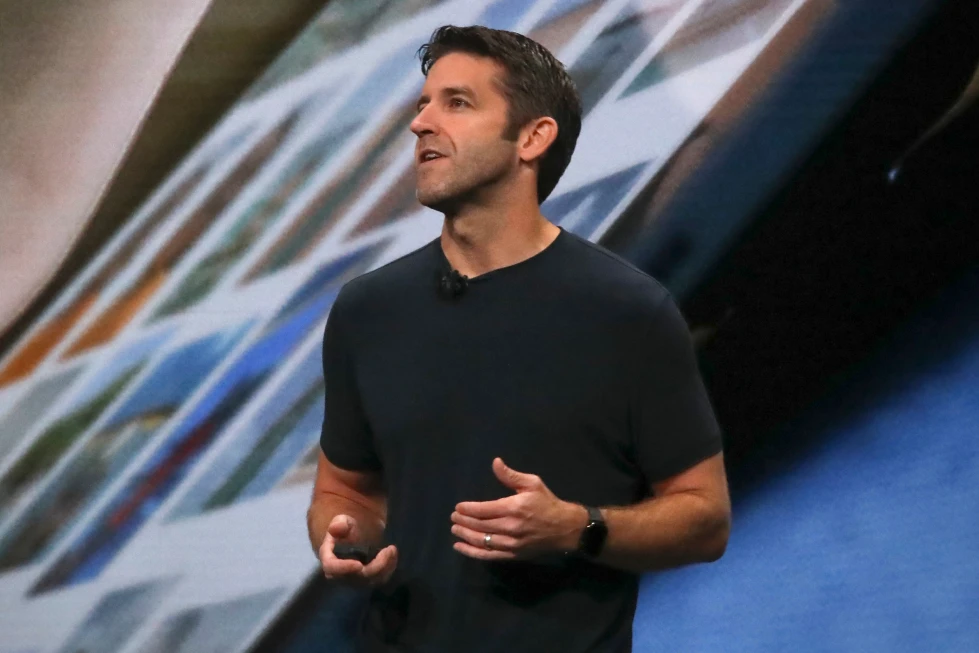
Apple has entered a new era with John Ternus formally taking over as chief executive from Tim Cook, ending one of the longest and most consequential leadership periods in the technology industry.
Ternus assumes control of the world’s most valuable technology company at a moment when Apple faces a strategic challenge markedly different from the one Cook inherited from Steve Jobs in 2011: artificial intelligence is rapidly reshaping the technology industry, while the iPhone — the product that powered much of Apple’s extraordinary expansion — is entering a more mature phase.
The transition became effective Tuesday, September 1, with Cook moving to the position of executive chairman. Apple’s market value has risen from roughly $350 billion when Cook became CEO to about $4.6 trillion today, according to the Associated Press.
The succession is therefore not simply a change of management. It marks a potential change in Apple’s strategic direction.
From supply-chain master to engineering chief
Cook’s Apple was defined by operational excellence, supply-chain optimisation, disciplined capital allocation and the continued monetisation of the iPhone ecosystem.
Ternus comes from a fundamentally different professional background.
The 50-year-old engineer has spent roughly a quarter-century at Apple and, over the past five years, led the engineering teams responsible for the iPhone, iPad and Mac. He also worked on products including the Apple Watch, AirPods and Vision Pro.
His appointment consequently puts an engineer at the centre of Apple’s next strategic chapter.
That may prove significant as the company attempts to accelerate its response to artificial intelligence.
“Cook created a major legacy at Apple but it was ultimately time to pass the torch to Ternus with the AI strategy now the focus,” Wedbush Securities analyst Dan Ives said in comments carried by The Zimbabwe Mail from Associated Press reporting.
AI becomes Ternus’ first major test
Apple’s biggest strategic weakness in recent years has been its slower progress in artificial intelligence.
While Microsoft, Google and other technology companies moved aggressively into generative AI, Apple struggled to deliver some of the artificial-intelligence capabilities it had promised for its devices.
The company has subsequently accelerated its efforts, including improvements to Siri and greater integration with external AI models.
Apple has also reportedly been testing integrations involving Google and Anthropic as it seeks to close the gap with competitors.
The issue is not simply whether Apple can build an AI model.
The strategic question is whether Ternus can turn AI into a new product and services growth engine without undermining Apple’s defining advantages — its hardware ecosystem, privacy positioning, software integration and control over the user experience.
That will require Ternus to move beyond his traditional engineering brief and make decisions about software, services, cloud infrastructure, data, partnerships and potentially acquisitions.
The iPhone problem
The more fundamental challenge may be the maturity of Apple’s core product.
The iPhone remains the centre of Apple’s ecosystem and an extraordinarily powerful cash-generating machine. But smartphones are no longer the transformative consumer technology they were when Jobs introduced the first iPhone in 2007.
The Associated Press describes the current AI revolution as the industry’s biggest upheaval since Jobs unveiled that first iPhone.
That creates a strategic imperative for Ternus.
Apple needs to develop products and services capable of producing the next significant growth cycle rather than simply extracting more revenue from an increasingly mature smartphone market.
Cook did oversee the creation of successful product categories, particularly the Apple Watch and AirPods, while Vision Pro represents an attempt to establish a new computing platform.
But none has yet approached the economic significance of the iPhone.
Forrester Research analyst Dipanjan Chatterjee previously described Cook’s record as having transformed Apple into a “durable, resilient financial powerhouse”, while also arguing that Cook had not overseen a technological breakthrough on the scale of the iPhone.
That may ultimately become the central question surrounding the Ternus era.
A new broom at Cupertino
Ternus now has an opportunity to redefine Apple’s investment priorities.
The company has enormous financial resources, an installed base of more than a billion active devices and one of the world’s strongest consumer brands.
The strategic question is where those resources should be deployed.
A more aggressive AI strategy could require substantially higher investment in computing infrastructure, artificial-intelligence talent and software development.
Apple could also increase investment in content and services, particularly Apple TV+, gaming and other subscription businesses, creating more recurring revenue streams that are less dependent on hardware replacement cycles.
The company could equally pursue new hardware categories where AI becomes the primary interface between consumers and technology.
That would represent a much more ambitious strategic departure from the incremental product evolution that has characterised much of the post-Jobs era.
Cook leaves, but does not disappear
Cook’s departure is also less absolute than previous technology leadership transitions.
He will become executive chairman, meaning Apple retains access to an executive who has spent 15 years managing its global supply chain, political relationships and corporate strategy.
That continuity could be particularly valuable given Apple’s exposure to geopolitical tensions and international manufacturing.
Cook developed close relationships with U.S. political leaders, including President Donald Trump, while navigating tariff disputes involving China and other Asian manufacturing centres.
Apple has subsequently diversified production, including moving more iPhone manufacturing towards India, while continuing to manage a complex global supply chain.
The AP reported that Cook is expected to help maintain Apple’s relationships with Trump and other important political figures after moving into the chairman role.
Wall Street will judge Ternus differently
Investors are unlikely to give Ternus much time simply because Apple is already enormously successful.
The company has reached a scale where maintaining growth becomes increasingly difficult.
A $4.6 trillion company needs enormous amounts of incremental revenue and profit to produce the same percentage growth it achieved when it was substantially smaller.
That means Ternus cannot rely solely on defending Apple’s existing franchises.
He must identify the next major growth engine.
AI is the obvious candidate, but it is also the area where Apple currently faces the greatest competitive pressure.
The market will therefore watch several indicators closely: the speed of Apple’s AI rollout, improvements to Siri, AI-related hardware demand, services growth, new product categories, capital expenditure and the extent to which Apple can convert its enormous installed base into new revenue streams.
A succession with unusually high expectations
Ternus is not inheriting a struggling company.
He is inheriting one of the most financially powerful corporations ever created.
That makes his challenge more difficult, rather than easier.
Cook demonstrated that Apple could thrive without Jobs and turned the company into a global financial powerhouse. But Ternus now faces a different question: what comes after the iPhone-led era?
The Associated Press noted that Ternus will have to move outside his hardware-engineering comfort zone, dealing with artificial intelligence, supply-chain strategy and relationships with powerful political figures.
For Apple, the handover therefore represents more than the end of Cook’s 15-year tenure.
It is the beginning of an experiment in whether an engineering-led leadership team can reinvent the world’s most valuable consumer technology company before the maturity of its flagship product becomes a constraint on growth.
Ternus’ first major public test comes almost immediately. He is expected to headline Apple’s upcoming iPhone launch at the company’s Cupertino headquarters.
The symbolism is difficult to miss: the engineer who helped build Apple’s current hardware platform is now being asked to build what comes next.


