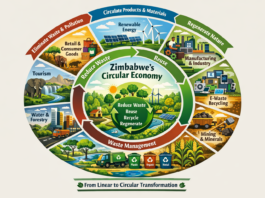

Zimbabwe is sitting on a silent crisis and an equally silent opportunity. Across urban centres, growth points, farms and mining areas lie thousands of derelict vehicles: rusting buses, abandoned haulage trucks, broken-down commuter omnibuses and private cars long past their useful life. They leak oil into the soil, block public spaces, and pose environmental and public health risks. Yet hidden within this decay is a powerful lesson about Zimbabwe’s broader economic challenge: we are still running a linear economy in a world that is rapidly turning circular.
By Claris Mutungwazi
A circular economy is built on a simple but transformative idea: resources should not be used once and discarded, but kept in productive use for as long as possible through reuse, repair, remanufacturing and recycling. For Zimbabwe, few sectors illustrate the urgency of this shift more clearly than transport and vehicles.
A Linear Economy With High Costs
Zimbabwe’s vehicle ecosystem is overwhelmingly import-dependent and largely informal at the end of life. Vehicles are imported—often second-hand—used far beyond their intended lifespan, and then abandoned or dismantled informally when they become uneconomic to repair. What follows is value destruction on a massive scale.
Steel, aluminium, copper, plastics and reusable components are lost through crude scrapping methods. Hazardous fluids seep into land and water systems. Local authorities inherit the burden of abandoned vehicles without the resources or legal tools to manage them. This is not just an environmental failure; it is an economic one.
In an economy constrained by foreign currency shortages and high import dependence, discarding valuable materials is an act of self-sabotage.
Vehicles as Material Banks
A circular economy reframes vehicles not as waste at the end of their life, but as material banks. A single vehicle contains recoverable metals, plastics and components that can feed local manufacturing, construction and energy sectors. Yet Zimbabwe lacks a coherent system to capture this value.
Globally, countries are moving towards strict end-of-life vehicle (ELV) rules that define when a vehicle becomes waste, require authorised treatment, and prohibit the export of non-roadworthy vehicles. These measures are not about environmental idealism; they are about economic realism. Materials retained locally strengthen industrial capacity and reduce reliance on raw material imports.
Zimbabwe, by contrast, has allowed its vehicle waste stream to leak value in every direction—into illegal dumping, cross-border exports of junk vehicles, and informal dismantling that benefits no one beyond short-term traders.
The Missing Vehicles Problem
One of the most visible symptoms of this failure is the phenomenon of “missing vehicles.” Cars written off by insurers, disposed of by fleet operators, or sold informally simply disappear from official records. Some are illegally exported. Others are stripped for parts in backyards. Many are abandoned.
This absence of traceability undermines road safety, environmental protection and revenue collection. It also exposes a deeper governance gap: Zimbabwe has no clear legal definition of when a vehicle ceases to be a vehicle and becomes waste.
Without that clarity, enforcement is impossible, and the circular economy remains a slogan rather than a system.
Why Import Standards Matter
Zimbabwe may not manufacture vehicles at scale, but it controls what enters its market. That leverage is underused. A circular-economy lens would prioritise vehicles that are durable, repairable and recyclable, while discouraging imports that are cheap upfront but costly in the long run.
Import standards linked to spare-part availability, hazardous materials, and recyclability would gradually improve the quality of the national fleet. Over time, this would reduce breakdowns, waste volumes and environmental harm—while creating demand for local repair, refurbishment and recycling industries.
Extended Responsibility, Not Municipal Burden
One of the biggest myths in Zimbabwe’s waste debate is that local authorities should manage everything. In reality, councils are among the least equipped institutions to deal with complex waste streams like vehicles.
A circular economy shifts responsibility upstream. Importers, distributors and large fleet owners should carry extended responsibility for the full life cycle of vehicles, including end-of-life collection and treatment. This is not punishment; it is accountability.
Such a system would unlock private investment into dismantling centres, recycling plants and remanufacturing hubs, activities far better suited to the private sector than overstretched municipalities.
Economic Opportunity in Disguise
The tragedy is that Zimbabwe’s vehicle waste problem is also an industrial opportunity. Formal vehicle dismantling can supply steel for foundries, copper for electrical uses, plastics for reprocessing and components for refurbishment. These are inputs Zimbabwe currently imports at high cost.
A well-regulated circular system could create jobs across skills levels, support SMEs, attract green investment and reduce pressure on foreign currency reserves. It aligns naturally with national goals on industrialisation, value addition and climate resilience.
Policy Coherence Is the Missing Link
What Zimbabwe lacks is not awareness, but coherence. Circular economy principles are scattered across environmental rhetoric, industrial policy and climate commitments—but rarely translated into enforceable systems.
The vehicle sector offers a practical starting point. Clear rules on end-of-life vehicles, traceability, exports and producer responsibility would send a strong signal that Zimbabwe is serious about turning waste into value.
A Choice About the Future
At its core, the circular economy is about choices. Zimbabwe can continue treating waste as an afterthought, cleaning up environmental damage after it occurs. Or it can redesign systems to prevent waste in the first place and extract value from what already exists.
The rusting vehicles scattered across the country are not just eyesores. They are reminders of an economy that still throws away what it can no longer immediately use. In a resource-constrained nation, that is a luxury Zimbabwe can no longer afford.
The shift to a circular economy is not optional; it is inevitable. The only question is whether Zimbabwe will lead, adapt, or be left managing the consequences of delay.