





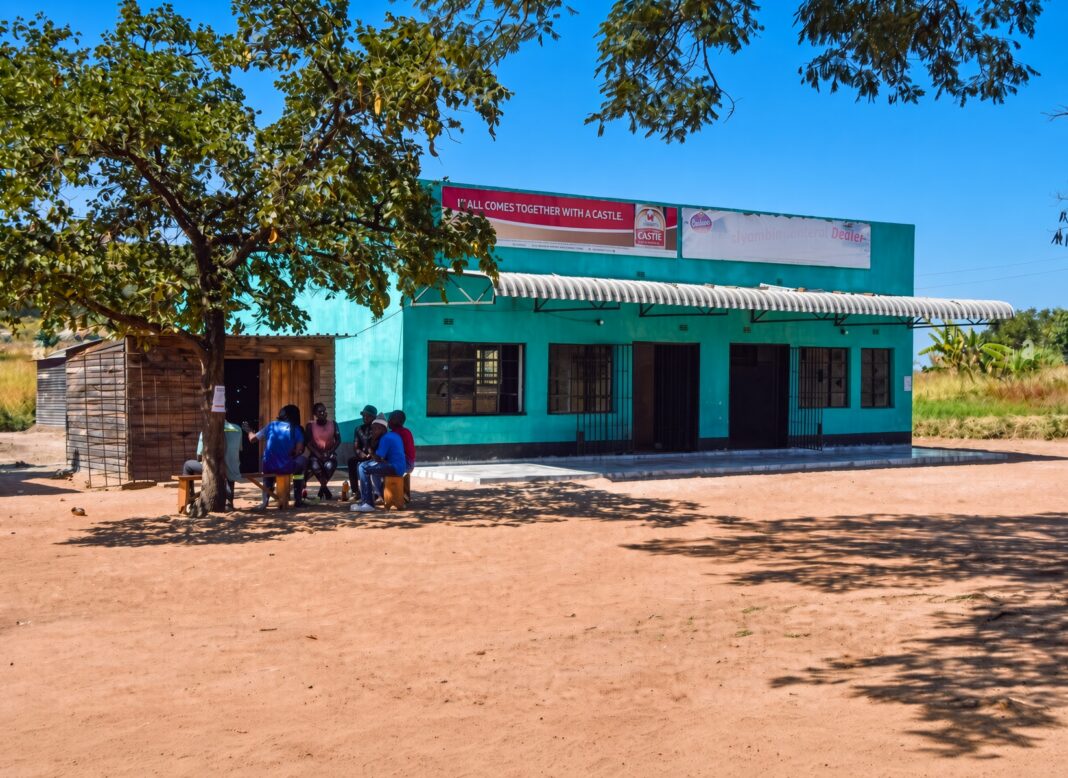
HARARE — The image (above) represent the standard model of a Zimbabwean rural shop that has existed since pre-independence Rhodesia; usually built on the dusty rural roadside and surrounded by open ground without other supporting infrastructure, it captures a much larger economic problem confronting Zimbabwe. The building may serve its immediate community, but it also represents the persistence of an outdated commercial architecture in a rural economy that has changed considerably beneath it.
Zimbabwe’s rural areas are no longer simply subsistence economies waiting for development to arrive from the cities. They are increasingly monetised consumer markets, agricultural production zones, remittance economies, construction markets and sources of entrepreneurial activity. New houses, schools, boreholes, solar installations, small businesses and transport services are appearing across the countryside. Yet the commercial infrastructure required to organise this economic activity into efficient markets has not developed at the same pace.
That is the central policy failure. Zimbabwe has spent considerable political energy discussing rural industrialisation, agricultural modernisation and rural development, but much less attention has been given to the mundane economic infrastructure through which rural people actually buy, sell, store, finance, transport and distribute goods.
The result is a peculiar form of economic dualism. Rural Zimbabwe is generating demand and, increasingly, producing goods, but much of that demand is still serviced through fragmented informal retail, roadside trading and isolated general dealers. The modern supermarket, wholesale distributor, warehouse, cold-storage facility, bank, insurance outlet, pharmacy, agro-dealer, restaurant, repair centre and professional-services business remain disproportionately concentrated in urban centres and larger towns.
This is not simply an aesthetic problem. It is a productivity problem.
The rural economy has changed, but the market architecture has not
Zimbabwe’s rural economy needs to be understood as a market rather than merely as a poverty-management problem. That distinction is fundamental. Once rural communities are treated as consumers and producers with purchasing power, commercial infrastructure becomes an economic development instrument rather than an afterthought.
The rural household that builds a US$30,000 or US$50,000 house is generating demand for cement, steel, roofing materials, electrical equipment, plumbing, furniture, appliances, transport and construction services. The farmer producing maize, tobacco, cotton, horticultural products or livestock generates another layer of demand for inputs, machinery, veterinary services, financial products, storage and logistics. Remittances add another stream of purchasing power.
But much of this expenditure eventually leaks out of rural communities because the commercial infrastructure needed to retain it locally does not exist.
A family may construct its house locally but travel to Harare, Bulawayo, Mutare or a regional town to purchase furniture. Farmers may produce agricultural commodities locally but travel long distances to find reliable buyers. Consumers may have money in their mobile wallets but still lack access to competitive retailers. Small businesses may have demand but lack wholesalers, formal banking facilities, cold storage, warehousing and reliable transport.
The consequence is a weak local economic multiplier. Money enters a rural economy, circulates briefly and then leaves again.
That is precisely what modern rural development policy should seek to reverse.
Zimbabwe’s two-tier economy requires two-tier economic policy
Zimbabwe should stop treating the country as one homogeneous market.
There is an urban economy and there is a rural economy, and while the two are interconnected, their economic structures, consumption patterns, logistics costs, population densities, income sources and infrastructure requirements are materially different.
A policy designed for central Harare cannot simply be transported to Tsholotsho, Chiredzi, Gokwe, Mudzi or Binga and expected to produce the same economic outcome.
The problem with a one-size-fits-all approach is that it mistakes national averages for economic realities. Rural markets require a different commercial geography. They depend on aggregation because population density is lower; they need strategically located trading centres because transport costs are higher; and they require infrastructure that combines retail, wholesale, agricultural marketing, storage, finance and services.
The policy objective should therefore not be to reproduce Harare in the countryside. It should be to build commercially viable rural nodes appropriate to rural economic geography.
That distinction matters enormously.
Zimbabwe has already tried the growth-point model — but stopped halfway
There is an important historical lesson here because Zimbabwe has not lacked ideas about rural development.
The country’s growth-point programme was conceived around the idea that strategically located rural centres could become focal points for services, employment, markets, processing and investment. Academic research on Zimbabwe’s growth-point policy has long identified the same fundamental weakness: many centres lacked a sufficiently strong economic base and meaningful linkages to the wider national economy, leaving some as little more than service centres or dormitory settlements.
That lesson should not lead Zimbabwe to abandon growth centres. It should lead it to redesign them.
A growth point cannot become an economic centre merely because Government declares it one. A commercial centre emerges when there is enough economic activity, infrastructure, purchasing power, logistics and private investment to sustain it.
The new model therefore needs to move from the administrative growth point to the commercial growth corridor.
A successful rural commercial centre should sit at the intersection of agricultural production, transport, retail demand and services. It should have a sufficiently large catchment population and should be designed around actual economic flows rather than political boundaries.
What Africa is learning about rural markets
There is now substantial evidence across Africa that rural infrastructure works best when roads, markets, storage, processing and finance are developed together.
Ghana provides a particularly relevant contemporary example. In 2026, the World Bank approved US$500 million for the Ghana Market Access and Connectivity Project, which combines rural road rehabilitation with agricultural value chains and market access. The programme targets more than 1,000 kilometres of rural roads and is explicitly designed to reduce transport costs, improve access to markets and allow farmers to move into higher-value agricultural activities.
The important lesson is that the road is not the final economic product. The road is an economic connector.
A road becomes development infrastructure when it connects a farmer to a buyer, a shopkeeper to a wholesaler, a processor to raw materials and consumers to competitive retailers.
Senegal is pursuing a similar integrated approach. Its rural connectivity programme combines roads with agricultural processing platforms, storage facilities, market areas, water infrastructure and other community facilities. The objective is to connect production areas to regional markets rather than merely to improve transport for its own sake.
This is precisely the conceptual shift Zimbabwe needs.
Uganda offers an even more instructive model
Uganda provides perhaps one of the strongest African examples of what a rural commercial market can actually look like.
African Development Bank-supported programmes have developed rural markets that combine retail stalls with storage, cold rooms, agro-processing and packaging facilities. Some markets have included rice mills, grain mills, fruit-processing equipment, cassava-processing machinery and honey-processing facilities, alongside water, electricity, sanitation and waste-management infrastructure.
The model is significant because it recognises that the rural market is not simply a place where someone sells tomatoes from a table.
It is a commercial platform.
A modern rural market can simultaneously function as a retail centre, wholesale centre, agricultural aggregation point, processing facility, logistics hub, financial-services location and social-commercial meeting place.
African Development Bank programmes in Uganda have also demonstrated the importance of strategic location. Rural markets perform better when placed in trading centres where there is already substantial agricultural exchange.
That is an important warning for Zimbabwe: building impressive structures in locations without sufficient economic activity is not development. It is construction.
Tanzania shows why storage and finance matter
Tanzania has also adopted an integrated approach to rural commercialisation. An African Development Bank programme combined district market centres with storage facilities, cold-storage infrastructure, feeder roads, value addition and rural financial services. The programme included support for community banks, savings institutions and agricultural lending mechanisms.
This is particularly relevant to Zimbabwe because rural commercial development cannot be separated from finance.
A rural trader needs working capital. A farmer needs seasonal finance. A wholesaler needs inventory finance. A cold-storage operator needs equipment finance. A transport operator needs asset finance.
Without rural financial intermediation, commercial infrastructure becomes underutilised.
Zambia’s agro-dealer model is another lesson
Zambia has experimented with agricultural service centres that function as one-stop rural commercial platforms for farmers. These centres provide access to agricultural inputs while incorporating warehousing and market-linkage functions.
Zimbabwe could adapt this model by creating Rural Commercial Service Centres rather than merely constructing traditional market stalls.
Such centres could house agro-dealers, banks, insurance companies, mobile-money agents, veterinary services, agricultural extension officers, equipment suppliers, produce buyers and logistics companies under one commercial roof.
That would immediately change the economics of rural production.
Ethiopia demonstrates the connection between rural markets and industry
Ethiopia has taken the concept further through integrated agro-industrial parks and supporting rural transformation centres. The approach connects agricultural producers to processing infrastructure, roads, markets, finance and industrial investment. African Development Bank-supported programmes have explicitly sought to integrate smallholder farmers and SMEs into commercial value chains while encouraging private investment and local value addition.
The lesson for Zimbabwe is profound.
Rural industrialisation does not mean putting a small factory in a rural area and calling the project industrialisation. It means building an ecosystem around production.
A dairy processor needs farmers, milk collection centres, refrigeration, roads, packaging, finance, electricity, retail distribution and consumers. A fruit-processing plant needs orchards, aggregation, grading, cold storage, transport, packaging and export logistics.
Industry is therefore only one component of rural industrialisation.
Commerce is the connective tissue.
China demonstrates what happens when rural commerce becomes digital
China offers an entirely different model, but one Zimbabwe should study carefully.
The emergence of the so-called Taobao Villages demonstrated that rural commercialisation does not necessarily require every consumer to travel to a physical shopping centre. Rural entrepreneurs began using digital platforms to sell products nationally and internationally, while local production, logistics and e-commerce became integrated.
Academic research has found that transportation infrastructure, education, local economic structure and government policy all influence the emergence of rural e-commerce clusters.
The significance for Zimbabwe is obvious.
The rural commercial centre of the future should not be purely physical.
It should be physical and digital.
A rural shopkeeper should be able to order stock electronically from a national wholesaler. A farmer should be able to check commodity prices before selling. A rural producer should be able to market honey, fruit, crafts, processed foods or agricultural products to customers outside the district. A small retailer should be able to access digital credit based on transaction history.
The mobile phone can become the rural equivalent of a shopping street.
But digital commerce still requires physical logistics. An online order ultimately needs a road, warehouse, collection point or delivery network.
The missing piece: rural commercial real estate
Zimbabwean economic policy has traditionally thought about rural infrastructure in terms of roads, dams, electricity, schools and clinics.
All are essential. But there is another category that deserves explicit policy recognition: rural commercial real estate. The country needs purpose-built commercial centres designed around rural demand.
These should not be enormous shopping malls. A rural commercial centre could begin with a supermarket or anchor retailer, a wholesale outlet, a pharmacy, bank or financial-service centre, agro-dealer, restaurant, hardware store, agricultural produce market, cold-storage facility, small warehouse complex and transport interchange.
The surrounding area could accommodate smaller businesses, workshops, salons, restaurants, professional services and informal traders.
This creates an economic ecosystem.
Instead of 50 isolated shops scattered along a road, the economy obtains a concentrated commercial node where infrastructure can be provided efficiently.
The South African lesson: retail follows the catchment
South Africa offers a useful regional example because its major retailers have increasingly recognised that underserved rural and peri-urban populations represent substantial consumer markets.
The principle is not complicated: retailers follow purchasing power when the population catchment, road access and property economics make investment commercially viable.
Zimbabwe should therefore stop asking whether rural populations are “poor” and start asking how much aggregate purchasing power exists within a 20-, 30- or 50-kilometre radius of a proposed commercial centre.
A rural household may have a lower monthly income than an urban household, but 20,000 households collectively represent an enormous market.
That is the correct unit of analysis.
The policy should create Rural Commercial Development Zones
Zimbabwe should establish a national Rural Commercial Development Programme based on economic geography rather than political patronage.
Each province could identify strategically located commercial nodes based on population catchment, agricultural production, road connectivity, household income, remittance flows, existing business activity and proximity to major markets.
Government would then provide the trunk infrastructure while private capital develops the commercial property.
The state should provide roads, electricity, water, telecommunications, drainage and serviced commercial land. Private developers should build and operate shops, warehouses, logistics facilities, markets and processing facilities.
This would be considerably more efficient than Government attempting to become the owner and operator of every rural business.
Public money should build the platform, not compete with entrepreneurs
One of the mistakes frequently made in rural development is confusing infrastructure provision with commercial operation.
Government should not necessarily operate the supermarket, warehouse or restaurant. Its role should be to make the commercial environment investable.
That means serviced land, secure property rights, reliable electricity, water, roads, telecommunications, predictable licensing and transparent taxation.
The commercial infrastructure itself can then be financed through public-private partnerships, development finance institutions, pension funds, banks, property developers and institutional investors.
A rural commercial centre can generate rental income, market fees, service charges, property rates and business taxes. Properly designed, it can therefore become financially self-sustaining.
Uganda’s experience is particularly instructive because some market programmes have envisaged public or community ownership while allowing private operators to manage commercial facilities, with market revenues contributing to maintenance.
Zimbabwe needs a rural retail logistics revolution
Retail distribution is perhaps the most immediate opportunity.
Zimbabwe’s national supermarket chains and wholesalers should be encouraged to develop rural distribution networks through franchises, agency arrangements and regional distribution centres.
The Government could establish incentives for retailers that establish stores in underserved commercial catchments, particularly where those investments are accompanied by local employment, domestic sourcing and SME supplier development.
The objective should be to create a rural distribution grid.
Instead of products moving directly from Harare into thousands of individual rural shops, distribution could operate through regional hubs feeding district-level wholesale centres and then smaller village retailers.
That would lower logistics costs, improve stock availability and reduce the price differential between rural and urban consumers.
Agriculture must be connected to commerce
The agricultural policy debate also needs to change.
Producing more maize, wheat, horticulture or livestock does not automatically generate rural prosperity. Farmers need markets.
That means collection centres, warehouses, grading facilities, cold rooms, commodity exchanges, processing plants, transport services and buyers.
The FAO has long emphasised that upgrading rural agricultural markets can strengthen rural incomes, food security and market linkages, while market infrastructure needs to be designed around the specific circumstances of the communities it serves.
Zimbabwe should therefore design agricultural and commercial policy together.
The farmer and the retailer are not separate economic actors. They are two sides of the same rural value chain.
Market infrastructure can also solve the informal-economy problem
Zimbabwe’s enormous informal economy is often discussed as a problem of tax compliance. That is too narrow. Informality is also an infrastructure problem.
When formal premises are expensive, unavailable or badly located, entrepreneurs naturally operate from pavements, roadside stalls, verandas and improvised structures.
A properly designed rural commercial centre can bring informal businesses into the formal economy without destroying them.
A trader who currently sells from a wooden stall could move into a serviced market unit with electricity, water, storage, digital payments and secure trading space.
The Government gains a taxable business. The trader gains a better operating environment. Consumers gain better hygiene and product choice.
Formalisation should therefore be achieved through commercial opportunity rather than administrative coercion.
Finance must follow the commercial infrastructure
The financial system should also be brought into the rural commercial strategy.
Every major rural commercial centre should have access to banking, mobile money, insurance, savings and credit.
Zimbabwe could establish a rural commercial-finance facility that uses partial credit guarantees to encourage banks to lend to retailers, processors, warehouse operators, transport companies and agricultural SMEs.
Long-term finance is particularly important because commercial property and agricultural infrastructure cannot be financed effectively through short-term working-capital loans.
Pension funds and insurance companies could also become important investors in rural commercial property if suitable investment structures and risk-sharing mechanisms were established.
Digital infrastructure should become part of the rural shopping centre
There is no reason a rural commercial centre should resemble a shopping centre of the 1990s.
It should be connected to broadband, mobile networks and digital payment systems.
A modern rural market could include digital price boards, online ordering, electronic stock management, agricultural market information, parcel collection, mobile banking and e-government services. The commercial centre could become the physical gateway into the digital economy.
China’s rural e-commerce experience demonstrates that local production can be connected to distant consumers through digital platforms, while research on rural e-commerce has shown the importance of transport, education and local economic ecosystems in sustaining such clusters.
Zimbabwe has an advantage that earlier generations did not have: it can leapfrog part of the traditional retail infrastructure through mobile technology.
Rural industrialisation should start with demand
There is another conceptual problem in Zimbabwe’s industrialisation debate. Policy makers often begin with the question: What factory can we build in this rural area?
The better question is: What economic demand already exists in this rural area, and what businesses are necessary to serve it?
If a district has thousands of cattle, there may be a commercial opportunity in meat processing, leather, veterinary services, feed, transport and cold storage.
If it has extensive horticulture, there may be demand for packhouses, refrigeration, packaging, logistics and processing. If remittances are high, there may be demand for housing materials, furniture, financial services and retail.
If mining activity is expanding, there may be demand for accommodation, food, equipment maintenance, transport and professional services.
Industrial policy should therefore be market-led rather than politically allocated.
The real opportunity is the rural multiplier
The most important economic concept here is the multiplier effect.
Suppose a farmer sells produce worth US$10,000. If there is no local commercial infrastructure, much of that income may immediately be spent elsewhere.
But if the district has a functioning commercial ecosystem, the farmer may buy inputs locally, employ local transporters, use a local bank, purchase household goods locally, eat at local restaurants, repair equipment locally and invest in local property.
The same dollar can circulate several times. That is how local economies deepen.
The objective of rural commercial policy should therefore be to increase the number of times income circulates locally before it leaks into another economic region.
Government should measure commercial access, not merely infrastructure kilometres
Zimbabwe’s development planning also needs better metrics.
A rural district should not be judged successful simply because it received 50 kilometres of roads or a new electrification project.
The Government should measure the average distance households travel to the nearest supermarket, bank, pharmacy, wholesale outlet, agricultural market and logistics centre. It should measure transport costs, market access, retail price differentials, commercial property occupancy, warehouse capacity, agricultural aggregation and local business formation.
These indicators would tell policymakers whether infrastructure is actually producing an economic ecosystem.
The World Bank’s research on African agricultural markets shows that remoteness, poor roads and inadequate storage can contribute to market volatility and weaken links between rural and urban markets.
That is why market accessibility should become a measurable development objective.
The photograph is therefore more important than it appears
The rural shop in the photograph is not simply an old-fashioned building.
It is an economic signal.
It tells us that Zimbabwe has a rural population with consumption needs, but has not yet built the commercial architecture necessary to serve those needs efficiently. The contrast between modern houses emerging behind traditional commercial structures is particularly revealing: private households are investing in their physical living environment faster than the economy is investing in the commercial environment surrounding them.
That is a form of private modernisation without corresponding market modernisation. And it is economically inefficient.
Zimbabwe cannot build a modern rural economy on the assumption that the rural general dealer will remain the principal distribution mechanism for everything from groceries and agricultural inputs to financial services and consumer goods.
From rural shops to rural economic districts
The policy ambition should ultimately be much larger.
Zimbabwe should move from the isolated rural shop to the rural economic district: a deliberately planned commercial node serving a defined population and production catchment.
Such a district could combine a supermarket, wholesale market, agricultural market, agro-dealer, warehouse, cold storage, bank, pharmacy, fuel station, restaurants, workshops, small offices, transport interchange, digital services and serviced SME premises.
Around it would develop housing, schools, clinics and light industry.
This is how rural development becomes cumulative rather than fragmented.
Zimbabwe already has the conceptual foundations for such a strategy. Its Vision 2030 framework recognises the importance of infrastructure as an enabler of economic transformation and specifically envisages rural electrification and end-use infrastructure supporting smallholder irrigation, schools, clinics and home industries at rural service centres and growth points.
What is missing is a much stronger commercial component.
The political economy must also change
This requires admitting an uncomfortable reality: rural development cannot be reduced to political visibility.
A borehole is visible. A road is visible. A new Government building is visible. But the invisible architecture of commerce is often more economically transformative.
A warehouse does not make a compelling political photograph. Neither does a cold-chain facility, a distribution centre, a commercial property fund or a digital wholesale platform. Yet these are the institutions that determine whether agricultural production becomes a business.
Zimbabwe therefore needs to move away from the politics of infrastructure projects towards the economics of market systems.
The objective should not simply be to construct rural infrastructure. It should be to create rural economies capable of attracting and retaining private capital.
A new rural development compact
The next generation of Zimbabwe’s rural policy should be built around a simple principle: rural people should not have to leave their communities to participate fully in the modern economy.
They should be able to buy competitively priced goods locally, access banking locally, obtain agricultural inputs locally, sell produce locally, access digital services locally, store commodities locally, process agricultural products locally and build businesses locally.
Some goods and services will inevitably remain concentrated in larger cities. That is normal. Economic geography will always produce urban centres of greater specialisation.
But basic commercial infrastructure should not be a privilege of metropolitan Zimbabwe.
The African experience demonstrates that rural roads, markets, storage, processing, finance and logistics work best when designed as interconnected systems rather than isolated projects. Ghana, Uganda, Tanzania, Zambia, Ethiopia and Senegal all provide useful lessons, while China’s rural e-commerce revolution demonstrates how physical commercial infrastructure can increasingly be integrated with digital markets.
Zimbabwe’s failure is therefore not that it has no rural economy. Quite the opposite. The rural economy is already there. It is producing, consuming, building, trading and accumulating wealth.
The failure is that policy has not built sufficiently sophisticated commercial institutions around it.
The rural shop in the photograph should consequently be understood not as an indictment of rural people, but of economic planning that has failed to recognise the changing nature of rural demand.
Zimbabwe does not merely need rural industrialisation. It needs rural commercialisation, rural logistics, rural finance and rural market infrastructure.
Until those four elements are developed together, rural industrialisation will remain largely a slogan.
The country does not need to turn every village into a city. It needs to create a network of commercially viable rural centres that allow production, consumption, finance and enterprise to interact locally.
That is the missing piece in Zimbabwe’s economic development architecture: not another policy announcement, but a functioning commercial geography capable of turning rural purchasing power and production into sustained local economic growth.


