





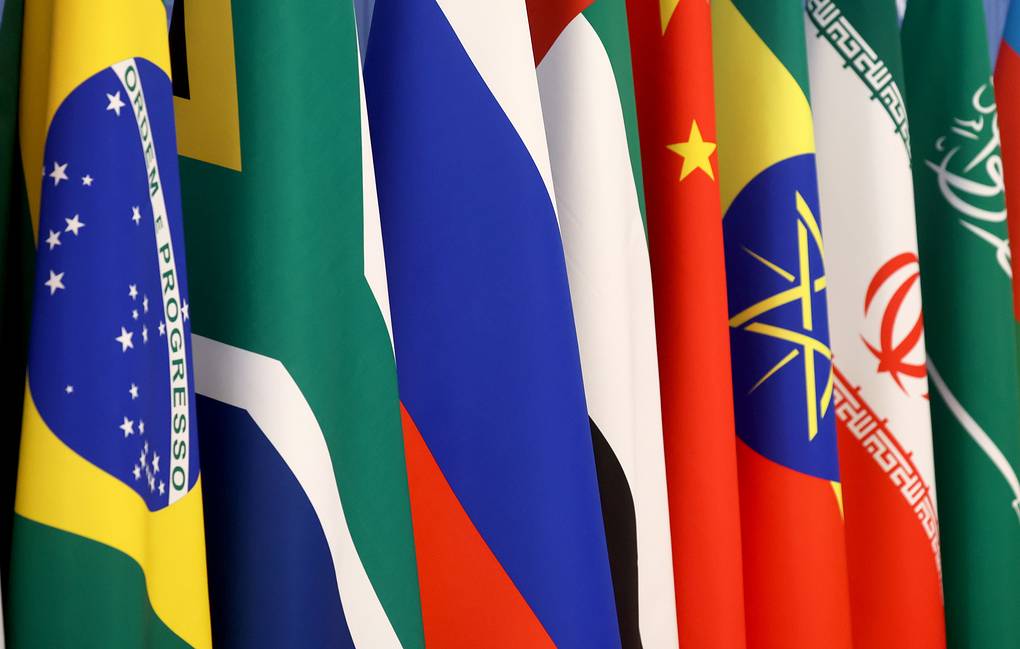
NEW DELHI — BRICS enters a more consequential phase this week as India hosts the grouping’s 18th summit, with the central economic question no longer simply how large the bloc has become, but whether its combined market, trade and financial weight can be converted into a more integrated economic system.
The summit, taking place in New Delhi on September 12–13 under the theme “Building for Resilience, Innovation, Cooperation and Sustainability,” is expected to focus on national-currency settlements, artificial intelligence, technology, energy and critical infrastructure.
Behind those discussions is a broader ambition: to make it easier for BRICS economies to trade, invest and finance development among themselves while reducing their dependence on financial and payment systems dominated by advanced Western economies.
BRICS began in 2006 as a four-country grouping of Brazil, Russia, India and China before South Africa joined in 2011. Since then, its economic significance has expanded substantially, with Egypt, Ethiopia, Iran and the United Arab Emirates becoming full members in 2024 and Indonesia joining in 2025.
The bloc now has 10 permanent members and 12 partner countries, giving it an economic and demographic footprint that extends well beyond its original BRIC configuration.
But size alone does not create economic power.
The more important test for BRICS is whether its members can convert their enormous combined demand, production capacity, commodity resources, capital and investment requirements into deeper intra-group economic linkages.
That is why the development of national-currency settlement mechanisms has become increasingly important.
Rather than immediately pursuing a common BRICS currency, members are focusing on the more practical problem of reducing the cost and complexity of cross-border transactions conducted through established international currencies and payment infrastructure.
A deeper local-currency trading system could potentially increase intra-BRICS trade, reduce foreign-exchange costs and create greater demand for member countries’ currencies. Over time, that could support the development of deeper regional capital markets and provide additional channels for financing infrastructure and productive investment.
The financial architecture is already beginning to take shape.
The New Development Bank, established in 2014 and headquartered in Shanghai, was created to finance infrastructure and sustainable-development projects across BRICS and other developing economies. It has authorised capital of $100 billion and, according to figures cited in the BRICS profile, has approved 120 projects worth approximately $39 billion.
The Contingent Reserve Arrangement provides another layer of financial cooperation, while the BRICS Business Council and other platforms are intended to strengthen commercial and investment relationships.
The strategic opportunity is therefore larger than creating an alternative payment mechanism. It is about building an ecosystem in which trade generates investment, investment generates productive capacity and productive capacity generates stronger intra-BRICS trade.
That distinction matters because BRICS remains economically diverse. China is a manufacturing powerhouse; India is emerging as a major technology and services economy; Russia is a significant energy and commodities producer; Brazil is an agricultural and natural-resources heavyweight; while South Africa provides a gateway into African markets.
The newer members add further energy, commodity, manufacturing and consumer-market capacity.
According to figures cited in the BRICS profile, the expanded grouping represents almost half of the world’s population. Its members accounted for about 30% of global GDP in 2025 at market exchange rates, while their combined share rises to approximately 39.2% on a purchasing-power-parity basis.
Those figures give BRICS considerable economic weight. But the next stage is about economic integration rather than economic arithmetic.
The bloc’s $1 trillion in intra-BRICS trade, cited by Russian officials in 2025, illustrates the potential scale of the market. Yet the deeper question is how much of that trade can be supported by local currencies, BRICS-based financial institutions, cross-border investment and common infrastructure rather than conventional intermediated channels.
This is where the New Delhi summit becomes significant.
For developing economies, the attraction of BRICS is not simply geopolitical. It is increasingly about access to capital, markets, technology, infrastructure finance and alternative channels for economic development.
The challenge is equally substantial. BRICS has no permanent headquarters, treaty-based institutional structure or single economic policy. Its members have different exchange-rate regimes, financial systems, development priorities and geopolitical interests.
Turning collective economic weight into collective economic power will therefore require practical institutions rather than political declarations.
The next phase of BRICS will ultimately be judged by whether businesses can trade more easily, investors can move capital more efficiently, infrastructure can be financed more cheaply and member economies can increase productive capacity through deeper economic cooperation.
That makes the New Delhi summit less about creating an alternative to the existing global economy and more about building greater economic optionality for the emerging world.
If BRICS can turn its demographic scale, commodity resources, industrial capacity and growing financial assets into a functioning network of trade, payments, investment and development finance, its economic influence could become considerably greater than the sum of its members.


