





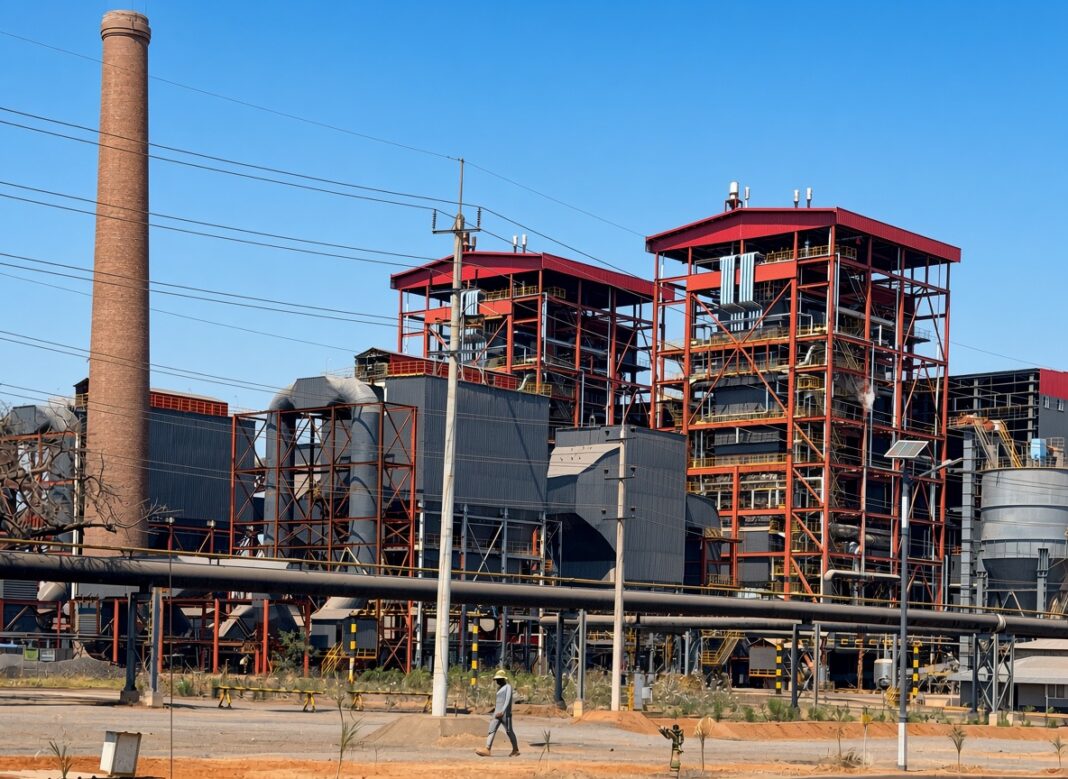
HARARE — Zimbabwe is seeking to turn its mineral wealth and energy resources into a broader manufacturing base, with the development of Xintai Industrial Park in Beitbridge emerging as one of the Government’s more ambitious attempts to build an integrated industrial economy outside the country’s traditional manufacturing centres.
Industry and Commerce Minister Nqobizitha Mangaliso Ndhlovu, who visited the project, said the scale and design of the development offered a practical illustration of the Government’s industrialisation strategy under the National Development Strategy 2.
Speaking to The Zimbabwe Financial Mail, Ndhlovu said the significance of Xintai extended beyond the individual factories being constructed.
“This is not simply a collection of industrial projects. What makes Xintai significant is the integration of mining, energy and manufacturing within one productive system,” Ndhlovu said.
At the heart of the development is a 100MW power-generation plant, designed to supply electricity to the industrial operations, including a steel plant, coking plant, fertiliser plant and the Tuli Coal Mine.
The project is also expected to incorporate a 380MW thermal power station, which will use gases produced by the coke oven batteries.
For Zimbabwe, where electricity shortages have historically constrained industrial output and forced companies to rely on expensive alternatives, the integration of power generation with industrial production could provide a significant competitive advantage.
“Energy is fundamental to industrialisation,” Ndhlovu told The Zimbabwe Financial Mail. “You cannot build a competitive manufacturing economy while leaving the energy question unresolved. Xintai is important because generation capacity is being developed alongside productive capacity.”
From mining to manufacturing
The development comes as Zimbabwe seeks to deepen mineral beneficiation and reduce its dependence on exports of relatively unprocessed commodities.
The industrial park’s proposed combination of coal mining, coke production, steel manufacturing, fertiliser production and cement manufacturing provides the potential for resources extracted locally to feed into downstream industrial processes.
The cement plant is nearing completion, while construction work on the fertiliser facility has begun, with commissioning expected in 2027.
The Government sees such industrial linkages as critical to increasing domestic value addition and retaining a greater proportion of the economic value generated by Zimbabwe’s natural resources.
“We have spent too long looking at our mineral resources primarily as sources of export revenue,” Ndhlovu said. “The next stage is to build industries around those resources so that extraction becomes the beginning of the value chain rather than the end of it.”


The strategy reflects a broader effort to rebuild Zimbabwe’s productive base after years of industrial contraction, foreign-exchange shortages, infrastructure constraints and weak investment.
Beitbridge’s strategic advantage
Xintai’s location in Beitbridge also gives the project a potentially important commercial dimension.
The border town is Zimbabwe’s principal southern gateway and sits on one of the country’s most important regional trade corridors, linking Zimbabwe with South Africa and the wider Southern African market.
An industrial cluster located along that corridor could potentially serve both domestic demand and regional markets, particularly if reliable power, transport infrastructure and competitive production costs are achieved.
Ndhlovu said the Government wanted industrialisation to spread beyond Harare and Bulawayo.
“Zimbabwe’s industrial economy cannot remain concentrated in a handful of urban centres,” he said. “We need productive activity to follow resources, infrastructure and market opportunities. Beitbridge has strategic advantages that can support that kind of development.”
Local companies face a test
The economic impact of Xintai will, however, depend partly on whether the project creates meaningful linkages with Zimbabwean businesses.
Large industrial investments can generate substantial economic activity without necessarily creating deep domestic supply chains if equipment, technical expertise and other inputs are predominantly imported.
The Government therefore wants local contractors, manufacturers, transport companies, suppliers and small and medium-sized enterprises to participate in the industrial park’s procurement ecosystem.
Ndhlovu said local participation would be an important measure of the project’s success.
“We don’t want an industrial enclave that is disconnected from the rest of the economy,” he said. “The objective is to create opportunities for local businesses through procurement, supplier development, skills transfer and technology.”
He said the Ministry would encourage stronger connections between major investors and domestic enterprises so that smaller companies could improve their productive capacity and eventually compete for contracts in regional and international markets.
Industrialisation with a social infrastructure
The development is also being accompanied by infrastructure designed to support a growing industrial community, including power and water systems, schools, hospitals, training facilities and other social amenities.
That element is significant because the Government’s industrialisation strategy increasingly views industrial development as an ecosystem rather than simply the construction of factories.
Ndhlovu said industrial projects must create communities capable of sustaining economic activity over the long term.
“You cannot have factories operating in isolation from the communities around them,” he said. “Workers need housing, schools, healthcare, training and other services. If those elements develop together, industrialisation can have a much wider economic and social impact.”
A test for NDS2
Xintai ultimately provides a test of whether Zimbabwe can move from announcing industrialisation ambitions to delivering large-scale productive capacity.
The Government’s National Development Strategy 2 places industrialisation, value addition, beneficiation and private-sector investment at the centre of efforts to transform the economy and advance the country’s Vision 2030 objectives.
For Ndhlovu, the significance of Xintai lies precisely in that transition.
“What matters now is moving from policy documents to production on the ground,” he said. “Industrialisation means factories producing, workers acquiring skills, businesses supplying those factories and natural resources being converted into higher-value products.”
If completed as envisaged, Xintai could provide Zimbabwe with a rare combination of mining, power generation and heavy manufacturing within a single industrial ecosystem.
But the project’s broader economic significance will ultimately be determined by whether it can achieve commercially viable production, secure reliable energy, integrate local companies and establish sustainable markets for its output.
For an economy attempting to rebuild its manufacturing base while extracting greater value from its natural resources, those outcomes could prove more important than the sheer size of the investment itself.


