





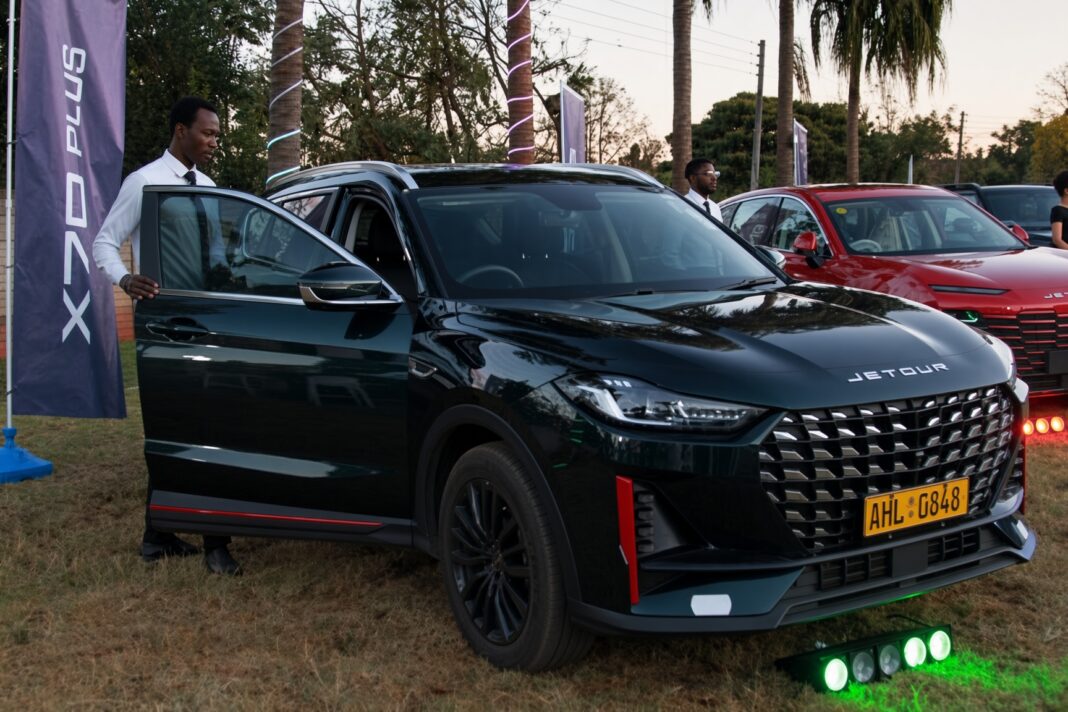
HARARE — Chinese vehicle manufacturers are betting that Zimbabwe’s appetite for modern SUVs can overcome one of Africa’s most difficult new-vehicle markets, as Jetour becomes the latest marque to enter a sector dominated by used imports and constrained by weak consumer financing.
Jetour formally launched its Zimbabwean operations last week, bringing the Dashing, X70 Plus, T1 and T2 to the market and signalling plans to expand its showroom and service network beyond Harare.
Becks Chen, vice-president of Jetour South Africa, described Zimbabwe as “a strategic market in the company’s African expansion strategy”, with additional showrooms and service centres planned for cities including Bulawayo and Mutare.
But the real test for Jetour — and the growing number of Chinese automotive brands targeting Zimbabwe — will not be attracting attention in a showroom. It will be persuading consumers to buy new vehicles in an economy where affordability, access to finance, resale values and after-sales support often matter more than technology or styling.
Jetour is attempting to tackle one of the biggest barriers directly: consumer confidence.
The company is offering a 10-year or one-million-kilometre engine warranty, backed by a parts supply chain and certified technicians. Its Zimbabwe website lists the Dashing and T1 from about US$37,900, while the X70 Plus and T2 start at about US$40,500.
The warranty is an aggressive proposition in a market where buyers have traditionally placed considerable value on mechanical durability, availability of spare parts and the ability to maintain a vehicle long after the original purchase.
As The Zimbabwe Financial Mail has observed in its assessment of the local automotive market, the fundamental problem is not simply a shortage of vehicles but the structure of Zimbabwean demand. Annual sales of new vehicles remain relatively small, at roughly 6,000 units, while a highly informal economy and limited access to vehicle finance push consumers towards cheaper second-hand imports.
That makes Zimbabwe a potentially attractive market for manufacturers with a low-cost production base, but a difficult one in which to build scale.


Chinese manufacturers nevertheless appear increasingly willing to make that bet.
Jetour joins brands such as BYD and Great Wall Motors in seeking to establish themselves in Zimbabwe as Chinese automotive companies move rapidly beyond their traditional markets. The broader global expansion of Chinese manufacturers is being driven by a combination of competitive pricing, increasingly sophisticated technology and a growing ability to provide vehicles across multiple segments.
Jetour itself has built a substantial international distribution network and is targeting more than 45 countries and regions.
Its Zimbabwe strategy is therefore not simply about selling a few hundred SUVs. The more important objective is to establish a distribution, servicing and parts ecosystem capable of supporting the brand over the long term.
That distinction matters in Zimbabwe.
A vehicle may be competitively priced at the point of purchase, but consumers will ultimately judge the brand on whether parts are available, whether technicians understand the vehicles, how expensive servicing becomes and, crucially, how much the car is worth when it is eventually sold.
For Chinese brands, resale value may prove one of the biggest battles.
Zimbabwean consumers have historically gravitated towards established Japanese brands partly because of their reputation for reliability and the depth of the second-hand market. A vehicle with an established resale market effectively carries its own liquidity premium.
Chinese manufacturers must therefore create that market almost from scratch.
Jetour is attempting to accelerate the process through its warranty and after-sales proposition. The company says it currently has one showroom and two service stations, with expansion planned into Bulawayo and Mutare. It also says its South African operation maintains more than US$3 million worth of spare parts, with emergency components capable of reaching Harare within three days.
The product strategy is equally deliberate.
The Dashing targets the urban crossover segment, the seven-seat X70 Plus is aimed at families, while the T1 and T2 are designed for buyers looking for more rugged SUVs.
That could give Jetour an advantage in a country where vehicle usage extends well beyond the paved urban environment. Zimbabwe’s motorists regularly navigate a mixture of highways, urban roads, gravel roads and rough terrain, creating a market in which SUV versatility carries genuine utility rather than simply lifestyle appeal.
Yet the biggest constraint remains economic.
A new vehicle costing tens of thousands of US dollars is beyond the reach of a large proportion of Zimbabwean households, particularly where formal employment and bank-based consumer credit remain limited. The result is a bifurcated automotive market: a relatively small formal new-vehicle segment alongside a much larger market for imported used vehicles.
For Chinese manufacturers, this presents both the opportunity and the problem.
Their competitive advantage is often strongest where they can offer more equipment and technology for a given price. But if the price gap between a new Chinese SUV and a used Japanese vehicle remains substantial, many Zimbabwean consumers may continue to prioritise affordability over novelty.
This is why vehicle finance could ultimately prove more important than showroom expansion.
If manufacturers and local financial institutions can develop affordable, predictable financing products for new vehicles, Chinese brands could begin converting Zimbabwe’s latent demand for newer, safer and more technologically advanced vehicles into actual sales.
Without that financial bridge, the addressable market will remain relatively narrow.
The emergence of Chinese manufacturers nevertheless marks an important shift in Zimbabwe’s automotive landscape.
For decades, the market has been shaped largely by established Japanese, European and American brands, with used imports filling the affordability gap. Chinese manufacturers are now challenging that model by bringing newer vehicles, aggressive warranties and increasingly sophisticated technology into the market.
The question is whether they can change consumer behaviour rather than simply add more brands to the showroom floor.
For Jetour, the one-million-kilometre warranty is therefore more than a marketing proposition. It is a calculated attempt to address the central question facing any new Chinese marque entering Zimbabwe: why should a consumer trust a relatively unfamiliar brand with a purchase that represents one of the largest discretionary investments they will ever make?


