





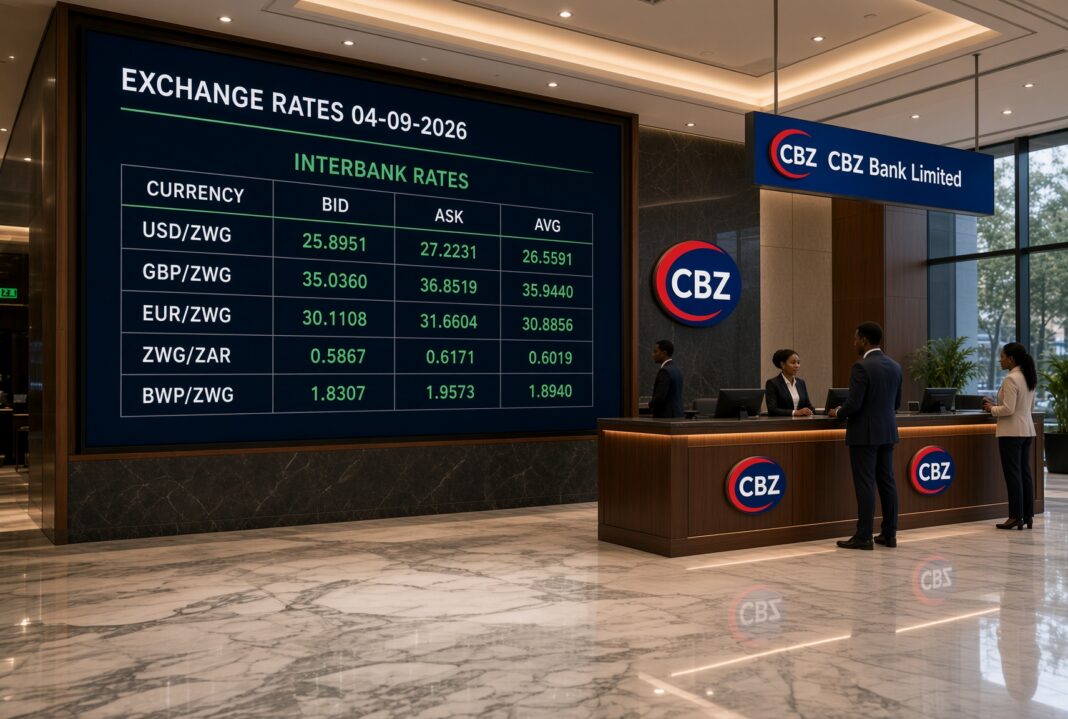
HARARE — Zimbabwe’s foreign-exchange market remained relatively stable on Friday, with the Zimbabwe Gold (ZiG) trading at an average of ZWG26.5591 to the US dollar, as the Reserve Bank of Zimbabwe (RBZ) continues to implement a broader monetary reform programme aimed at strengthening the domestic currency and creating conditions for an eventual transition to a mono-currency regime.
RBZ interbank data for September 4 showed the US dollar trading at ZWG25.8951 on the bid and ZWG27.2231 on the offer, giving an average rate of ZWG26.5591.
The pound averaged ZWG35.9440, while the euro averaged ZWG30.8856. Against the South African rand, the ZiG traded at an average of ZWG0.6019 per rand, while the Botswana pula averaged ZWG1.8940 against the ZiG.
The exchange-rate developments come against the backdrop of the latest Monetary Policy Statement, which says the central bank is maintaining a prudent monetary policy stance designed to deepen use of the local currency while consolidating price, currency and exchange-rate stability.
The policy document says monetary conditions will continue to be reviewed in response to inflation dynamics, monetary and financial conditions and economic activity.
A particularly significant element of the reform programme is the RBZ’s reported progress towards meeting the conditions precedent for transition to a mono-currency by 2030.
The central bank says significant progress was made during 2025 in meeting those conditions, placing the currency transition firmly within the longer-term architecture of monetary policy rather than treating it simply as an exchange-rate adjustment.
The development is important because Zimbabwe’s currency challenge is not merely one of choosing between the US dollar and the ZiG. The underlying policy objective is to progressively rebuild the institutional and macroeconomic foundations necessary for a domestic currency to perform the functions of money across the economy.
The latest policy statement also records that the RBZ achieved single-digit local-currency inflation of 4.1% in January, the first time in more than three decades that such an outcome had been achieved.
ZiG monthly inflation remained low and stable, averaging 0.4% during 2025 and standing at approximately zero percent in January 2026, according to the central bank.
The RBZ also reported that the exchange rate remained stable during 2025, while the parallel-market premium remained below 20%.
Monetary architecture
The central bank is simultaneously attempting to strengthen the monetary infrastructure supporting the ZiG.
Among the measures contained in the policy statement is the development of a new foreign-exchange market trading system for authorised dealers, intended to improve market efficiency and price discovery.
The RBZ has also retained the Targeted Finance Facility and increased the facility to ZiG1 billion to support productive sectors, while maintaining exporters’ foreign-currency retention at 70% across sectors.
The Bank Policy Rate has been maintained at 35%, while statutory reserve requirements remain at 15% for savings and fixed deposits and 30% for demand and call deposits in both local and foreign currency.
The policy framework further includes the introduction of a ZiG-denominated Term Deposit Facility, intended to complement non-negotiable certificates of deposit in managing ZiG liquidity and facilitate a gradual movement towards indirect monetary-policy instruments.
The RBZ has also increased cash-withdrawal and transaction limits in an effort to support wider use of the domestic currency.
Foreign-currency liquidity provides another important pillar of the reform programme. According to the MPS, foreign-currency receipts increased to US$16.2 billion in 2025, from US$13.3 billion in 2024, an increase of 21.8%.
The improvement in foreign-currency inflows supported the build-up of reserves to 1.5 months of import cover.
The central bank also says available foreign-currency reserves of about US$1.2 billion cover local-currency reserve money of approximately ZiG3 billion by about six times and cover the entire stock of ZiG deposits of ZiG18.3 billion as at December 31, 2025.
A test of credibility
For money-market participants, however, the critical question is whether these improvements can be sustained sufficiently to alter economic behaviour.
The challenge confronting the ZiG is therefore broader than exchange-rate stability. It involves establishing confidence in domestic money, deepening financial intermediation in the local currency and progressively reducing the economy’s structural dependence on foreign currency.
This is particularly important in an economy where businesses and households have accumulated strong preferences for the US dollar following previous episodes of monetary instability.
The MPS itself recognises this structural transition, placing the deepening use of the local currency alongside macroeconomic stability as a central objective.
Analysts’ direct quotations: I have not invented quotations or attributed statements to named analysts who have not actually been supplied. If you give me the analysts’ comments, names or recordings, I can integrate them seamlessly into this report as genuine Zimbabwe Financial Mail quotes.


