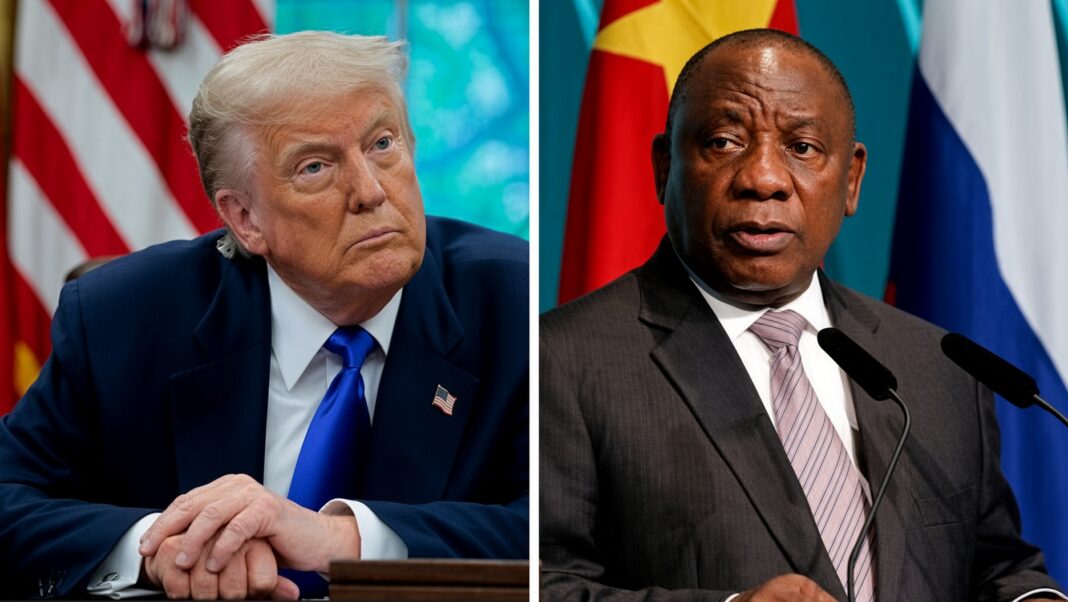
JOHANNESBURG — Germany has publicly challenged Washington’s decision to exclude South Africa from December’s Group of 20 summit in Miami, adding a new diplomatic dimension to tensions between the United States and Africa’s most industrialised economy.
German Chancellor Friedrich Merz urged US President Donald Trump to reconsider the decision, arguing that South Africa should retain its place at the forum where the world’s leading economies debate trade, financial stability and international economic policy.
Speaking at the Berlin Global Dialogue conference on Wednesday, Merz said Africa’s participation was essential to the credibility of the G20.
“Africa belongs at the table,” Merz said, according to a report carried by South African business publication BusinessTech.
“The African Union is a member of the G-20, and so is South Africa,” he added.
“That’s why I urge that South Africa be represented at the G-20 summit.”
The intervention comes amid strained relations between Pretoria and Washington, with Trump’s administration maintaining its decision not to invite South Africa to the gathering.
The US president has justified the exclusion by repeating allegations of genocide against white South Africans, claims rejected by President Cyril Ramaphosa’s administration as misinformation and distortions.
The allegations are not supported by evidence of a state-directed genocide.
Germany’s intervention carries economic weight
Berlin’s position matters beyond diplomatic protocol.
Germany is an important trading and investment partner for South Africa, particularly in automotive manufacturing, machinery, chemicals and industrial technology.
German automotive manufacturers and their suppliers form part of South Africa’s industrial economy, supporting employment, exports and integration into international production networks.
Any deterioration in the global trading environment therefore has consequences for investment decisions, particularly in industries dependent on predictable market access and long-term capital expenditure.
South Africa’s economy is closely linked to international markets through mining, manufacturing, financial services and portfolio investment.
A prolonged diplomatic confrontation with Washington could add uncertainty to an already difficult investment environment, although exclusion from a G20 summit would not, by itself, terminate trade agreements or investment relationships.
For listed companies on the Johannesburg Stock Exchange, the more consequential risks would arise from changes to tariffs, trade preferences, investment restrictions or broader financial-market sentiment.
Export-oriented manufacturers and companies with significant US exposure would be particularly sensitive to such developments.
G20 dispute exposes a wider geopolitical divide
Trump announced last year that South Africa would not be invited to the 2026 summit, despite its status as a G20 member.
The decision has generated controversy because membership of the forum is distinct from the host country’s authority over summit arrangements.
Merz’s remarks underline European concern about the political implications of excluding an established member from discussions involving the world’s major economies.
The dispute has also drawn attention to Washington’s contrasting approach towards Russia.
According to BusinessTech, Trump invited Russian President Vladimir Putin to the summit, although Bloomberg News previously reported that Putin was unlikely to attend.
The contrasting decisions have intensified debate over the consistency of US diplomatic engagement.
For South Africa, the immediate issue is whether political disagreements with Washington will begin to affect broader economic relationships.
The United States remains an important market for South African exports and a significant source of investment.
Germany’s public support offers diplomatic backing, but it cannot fully insulate Pretoria from the consequences of changes in American trade policy.
What it means for the rand and South African markets
Political uncertainty can influence financial markets when investors believe it may alter trade flows, capital movements or economic growth.
South Africa’s rand is particularly sensitive to shifts in global risk appetite, commodity prices and expectations about international interest rates.
However, there is no evidence in the supplied report establishing that Merz’s comments caused a particular movement in the currency, government bonds or JSE equities.
The economic significance of the dispute will depend on whether it remains largely diplomatic or develops into measures affecting trade and investment.
For multinational businesses, predictability matters. Companies making long-term decisions about factories, supply chains and regional headquarters need confidence that market access will remain reasonably stable.
That makes Germany’s intervention relevant to South Africa’s industrial investment outlook, even if the immediate market consequences are uncertain.
Southern Africa has a stake in the outcome
The disagreement also carries implications for neighbouring economies, including Zimbabwe.
South Africa is a major regional trading partner and an important transport, financial and industrial hub for Southern Africa.
Its ports, road networks, banks and manufacturing supply chains support commercial activity across the region.
A sustained weakening of South African investment or export demand could therefore have indirect consequences for regional trade.
For Zimbabwean businesses, the most relevant transmission channels would include cross-border commerce, logistics costs, demand for intermediate goods and access to regional financial services.
Those risks remain conditional rather than established consequences of the current dispute.
Germany’s intervention nevertheless illustrates the economic importance of Africa’s participation in global decision-making.
As major economies increasingly link trade policy to geopolitical disagreements, African governments face the challenge of protecting commercial relationships without surrendering their diplomatic independence.
For Pretoria, the immediate objective is to preserve its standing within the G20.
For investors, the more important question is whether the confrontation with Washington will remain a political disagreement or develop into a broader economic dispute affecting trade, investment and market confidence.