





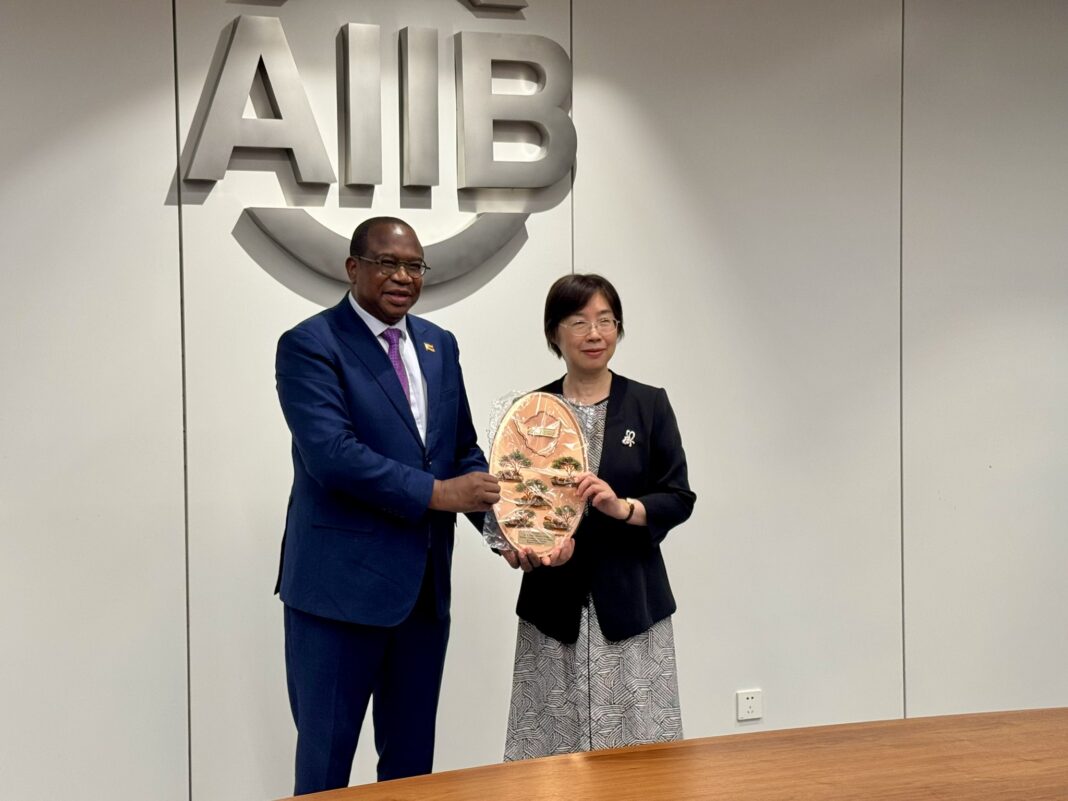
BEIJING – Zimbabwe has taken a significant step towards expanding its access to international development finance after formally engaging with the Asian Infrastructure Investment Bank (AIIB) in Beijing, a move that could unlock billions of dollars in long-term infrastructure funding and strengthen the country’s economic transformation agenda.
The high-level engagement follows Zimbabwe’s formal expression of interest in joining the Beijing-headquartered multilateral development institution in May 2026 through a letter addressed to AIIB President and Chair of the Board of Directors, Jiayi Zou.
Leading the Zimbabwean delegation was Finance, Economic Development and Investment Promotion Minister Professor Mthuli Ncube, accompanied by senior Treasury officials, who met with AIIB President Jiayi Zou and the bank’s executive management team to discuss Zimbabwe’s development priorities and the prospects for future cooperation.
The discussions centred on Zimbabwe’s National Development Strategy 2 (NDS2) covering the period 2026 to 2030, as well as the country’s broader Vision 2030 agenda, which seeks to transform Zimbabwe into an upper-middle-income economy through accelerated industrialisation, infrastructure development and private sector-led growth.
The engagement represents more than a diplomatic milestone. Economists say potential membership of the AIIB could provide Zimbabwe with access to a major new source of infrastructure financing at a time when developing economies are increasingly competing for capital to modernise transport systems, energy networks, water infrastructure and digital connectivity.
Established in 2016 and now comprising more than 100 member countries, the AIIB has emerged as one of the world’s most influential development finance institutions, funding large-scale infrastructure projects across Asia, Africa, Europe and Latin America. The bank was created to address infrastructure financing gaps and has rapidly built a multi-billion-dollar lending portfolio focused on sustainable development.


During the meeting, AIIB officials outlined the institution’s four strategic priorities: sustainable infrastructure development, green and climate-resilient infrastructure, regional connectivity and integration, and mobilisation of capital for private sector development financing.
These priorities closely align with Zimbabwe’s own economic objectives, particularly as the country seeks to overcome infrastructure deficits that have constrained industrial growth and investment competitiveness for decades.
Professor Ncube highlighted the convergence between Zimbabwe’s development agenda and the bank’s investment priorities, particularly in areas such as renewable energy, water security, irrigation infrastructure and climate adaptation projects.
He noted that Zimbabwe is actively seeking long-term development financing and technical partnerships to expand sustainable energy generation and hydro-infrastructure systems, both of which are critical to supporting economic growth, agricultural productivity and industrialisation.
The importance of such financing cannot be overstated. Infrastructure remains one of the biggest constraints to Zimbabwe’s economic expansion. Frequent electricity shortages, ageing water systems, transport bottlenecks and climate-related challenges continue to increase the cost of doing business and limit the country’s competitiveness in regional and global markets.
Access to AIIB funding could significantly accelerate major infrastructure projects while reducing dependence on short-term and expensive financing mechanisms.
The potential benefits extend beyond infrastructure alone. Improved transport networks would lower logistics costs for exporters, making Zimbabwean products more competitive in regional and international markets. Enhanced energy infrastructure would support manufacturing growth, mining expansion and agricultural processing industries. Investments in water infrastructure would strengthen irrigation capacity and improve resilience against recurring droughts that have affected agricultural output.
The meeting also underscored Zimbabwe’s growing international credibility following recent macroeconomic stabilisation efforts.
AIIB President Jiayi Zou reportedly commended Zimbabwe’s progress in restoring macroeconomic stability, particularly the achievement of single-digit inflation, describing the gains as an important foundation for sustainable development and long-term infrastructure investment.
Her remarks are significant because international financial institutions typically place strong emphasis on macroeconomic stability when evaluating investment and lending opportunities. Stable inflation, fiscal discipline and predictable economic policies reduce investment risk and improve the viability of large-scale infrastructure projects.
The positive assessment from the AIIB leadership is likely to be viewed favourably by international investors and development partners who continue to monitor Zimbabwe’s economic reform programme.
Beyond infrastructure financing, AIIB membership could also strengthen Zimbabwe’s economic engagement with Asia, the world’s fastest-growing economic region. Membership would provide access to technical expertise, project preparation facilities and potential co-financing arrangements with other multilateral development institutions.
For Zimbabwe’s trade sector, enhanced infrastructure financing could prove transformative. Improved roads, railways, border facilities and energy systems would facilitate greater participation in regional value chains under the African Continental Free Trade Area (AfCFTA), while reducing export costs and attracting export-oriented investment.
The country’s mining sector could particularly benefit from improved infrastructure, enabling greater value addition and mineral beneficiation. Agriculture could also gain from expanded irrigation infrastructure and improved logistics networks, supporting efforts to increase agricultural exports and food security.
Private sector development is another area likely to receive a boost. One of AIIB’s strategic pillars focuses on mobilising capital for private sector financing, which could create new opportunities for Zimbabwean businesses seeking investment in manufacturing, logistics, renewable energy and technology sectors.
The engagement comes at a time when many African countries are increasingly looking towards emerging multilateral institutions to complement traditional sources of development finance. As global competition for infrastructure investment intensifies, access to institutions such as the AIIB is becoming an important component of national development strategies.
Both Zimbabwe and the AIIB agreed to continue technical discussions regarding the country’s prospective membership and the development of a future project pipeline. The commitment reflects a shared interest in advancing sustainable, inclusive and climate-resilient infrastructure growth.
For Zimbabwe, successful accession to the AIIB could represent a significant turning point in its development financing strategy. Beyond providing access to capital, membership has the potential to accelerate infrastructure modernisation, strengthen trade competitiveness, attract private investment and support the country’s ambition of achieving upper-middle-income status by 2030.
As infrastructure increasingly becomes the foundation upon which modern economies compete, Zimbabwe’s engagement with the AIIB may ultimately prove to be as much about future trade and industrial growth as it is about financing roads, dams and power stations.


