
LONDON — European allies reacted with outrage Wednesday after the Trump administration sanctioned online safety campaigners accused of censoring “American viewpoints.”
The five people Secretary of State Marco Rubio banned from entering the United States include a former top European Union official and four high-profile activists against hate speech and disinformation on social media.
Rubio accused the five sanctioned figures of leading “organized efforts to coerce American platforms to censor, demonetize, and suppress American viewpoints they oppose.”
These “radical activists and weaponized NGOs have advanced censorship crackdowns by foreign states,” he added, using the acronym to refer to nongovernmental organizations. “The Trump administration will no longer tolerate these egregious acts of extraterritorial censorship.”
It marks a dramatic escalation of Washington’s war on what it sees as censorship from across the Atlantic. Europe has previously seen Vice President JD Vance berate its leaders over perceived failures on free speech.
For many on the continent and elsewhere, however, the move comes as an amplification of the Trump administration’s own crackdown on viewpoints that don’t align with its own.
The pushback from Washington also comes after European attempts to regulate American tech giants such as the Elon Musk-owned platform X, which was fined 120 million euros (around $140 million) by the European Union earlier this month for “breaching transparency obligations.”
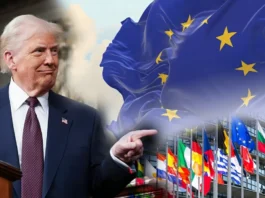
The European Commission, which is the E.U.’s executive arm, as well as the German Justice Ministry and French President Emmanuel Macron all condemned the move.
Macron called it “intimidation and coercion aimed at undermining European digital sovereignty.”
The European Commission warned that “if needed, we will respond swiftly and decisively to defend our regulatory autonomy against unjustified measures,” while European Council President António Costa said that “such measures are unacceptable between allies, partners, and friends.”
The most high-profile figure given a visa ban was Thierry Breton, the European Commission’s former top technology regulator, described by the State Department as the “mastermind” of a landmark piece of legislation called the Digital Services Act.
Musk said back in 2022 that he supported the law, but began to change with the fine against X — the first under the new legal powers — which he called “bulls—.” He has also referred to Breton as a “tyrant of Europe,” while Rubio and JD Vance both condemned the fine.
“Is McCarthy’s witch hunt back?” Breton wrote on X, referring to the 1950s anti-communist campaign led by Republican Sen. Joseph R. McCarthy. “To our American friends: ‘Censorship isn’t where you think it is.’”
Also sanctioned was Imran Ahmed, CEO of the Center for Countering Digital Hate, which says it holds to account social media companies that “erode basic human rights and civil liberties by enabling the spread of online hate and disinformation.”
Sarah B. Rogers, the under secretary of state, called Ahmed a “key collaborator with the Biden administration’s effort to weaponize the government against U.S. citizens.”